From Bathtubs to Battleships: How Buoyant Force Keeps 100,000 Tons Afloat
The USS Gerald R. Ford weighs about 100,000 tonnes fully loaded. That's roughly 980,000,000 newtons of gravitational pull aimed straight at the ocean floor. Yet the ship doesn't budge downward. The buoyant force calculator on this page runs on the exact same physics keeping that carrier afloat: Fₕ = \u03C1Vg, Archimedes' principle reduced to three measurable quantities. Punch in a fluid density, a displaced volume, and the local gravity, and you get the upward force in newtons — no approximations, no hidden assumptions.
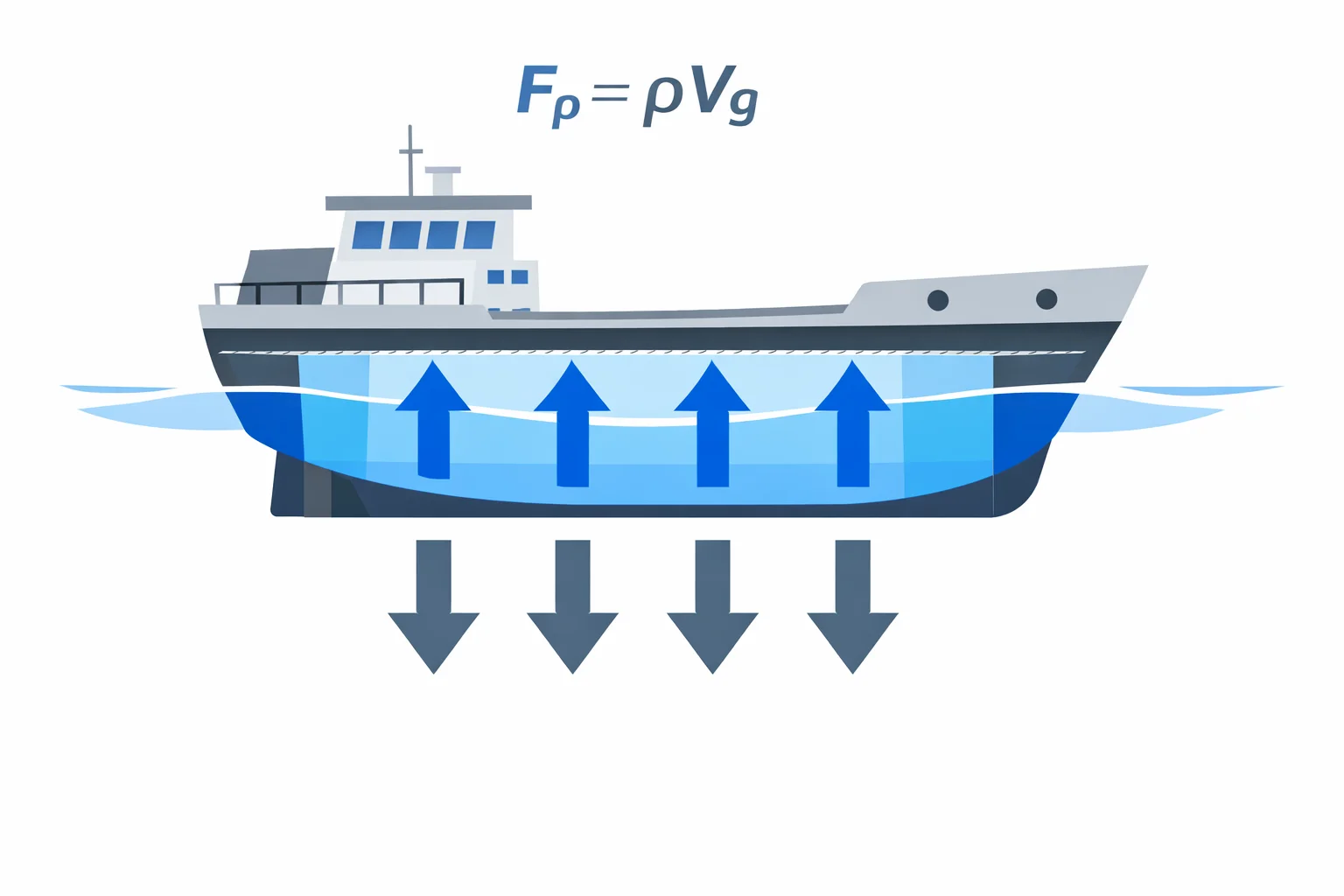
A Carrier That Weighs Nothing (to the Ocean)
Stand on a dock and watch any large vessel. The hull displaces seawater equal to the ship's mass — for the Gerald Ford, that's roughly 97,000 m³ of seawater at 1,025 kg/m³. Multiply 97,000 × 1,025 × 9.81 and you get approximately 975 MN of upward force. The ship's weight matches it almost perfectly, so the net vertical force is near zero. The ocean doesn't “feel” the carrier's weight — it feels the pressure difference between the bottom of the hull and the surface, and that difference produces exactly enough push.
This isn't unique to military hardware. A 300,000 DWT supertanker, a kayak, a rubber duck — the same equation governs them all. The only variables that matter are the fluid's density, the volume the object shoves aside, and the gravitational field strength.
Archimedes' Equation: Three Quantities, One Upward Push
The buoyant force on any object, partially or fully submerged, is:
Fₕ = \u03C1 × V × g
where \u03C1 is the fluid density (kg/m³), V is the displaced fluid volume (m³), and gis gravitational acceleration (m/s²). The product \u03C1V gives the mass of displaced fluid; multiplying by g converts that to a force in newtons. Nothing else enters the equation — not the object's material, not its shape above the waterline, not the depth at which it sits.
That last point trips up students more than any other. A beach ball held 1 m underwater and a beach ball held 10 m underwater experience the same buoyant force, because both displace the same volume of water. Depth increases hydrostatic pressure on the ball's surface, but the net upward force — the difference between pressure on the bottom and pressure on the top — stays constant. When that fluid is also moving, Bernoulli's equation governs how pressure and velocity trade off along the flow.
Steel Ships and Hollow Geometry
Steel's density is 7,850 kg/m³ — nearly eight times denser than water. A solid steel cube sinks immediately. So how does a steel ship float? Because ships aren't solid cubes. A hull is a thin shell enclosing a huge volume of air. The averagedensity of the ship-plus-air system is what matters, and for a loaded cargo vessel that average sits around 800–900 kg/m³, comfortably below seawater's 1,025.
Consider a simplified box barge: 100 m long, 20 m wide, 10 m tall, made from 3 cm thick steel plate. The steel volume is roughly 360 m³, weighing 2,826 tonnes. The total enclosed volume is 20,000 m³. To float in seawater, the barge only needs to submerge until the displaced water weighs 2,826 tonnes — that's about 2,757 m³ of seawater, requiring a draft of just 1.38 m. Over 86% of the barge sits above the waterline. You can use the potential energy calculator to figure out how much gravitational PE that barge stores at its floating height relative to the seabed.
Worked Example: Submarine Ballast Tank Flooding
A Virginia-class submarine has a surfaced displacement of about 7,800 tonnes and a submerged displacement of roughly 7,900 tonnes. To dive, the crew floods ballast tanks with seawater. Let's trace the physics:
- Surfaced:Hull volume \u2248 7,900 m³. Displaced seawater = 7,800 m³ (partial submersion). Buoyant force = 7,800 × 1,025 × 9.81 = 78.4 MN. Weight = 7,800 × 9,810 = 76.5 MN. Net upward force \u2248 1.9 MN keeps the sail and upper hull above water.
- Flooding ballast:Seawater fills ~100 m³ of tanks, adding roughly 102.5 tonnes. Total mass rises to \u22487,900 tonnes.
- Submerged:Displaced volume now equals the full hull volume: 7,900 m³. Buoyant force = 7,900 × 1,025 × 9.81 \u2248 79.4 MN. Weight = 7,900 × 9,810 \u2248 77.5 MN. The sub achieves near-neutral buoyancy and can fine-tune depth with trim tanks.
The difference between floating and diving is just 100 tonnes of seawater — barely 1.3% of the vessel's total mass. That thin margin is what gives submarines their precise depth control. If you want to see how the energy cost of pumping that ballast water translates to work done, check the work calculator.
Density Table: What Floats Where
Whether an object floats depends entirely on the density comparison: \u03C1ₒbject < \u03C1ₒluid means float, > means sink. Here's a reference table with real measured densities:
| Material | Density (kg/m³) | Freshwater? | Seawater? | Mercury? |
|---|---|---|---|---|
| Cork | 120 | Floats (88% above) | Floats (88% above) | Floats (99% above) |
| Balsa wood | 160 | Floats (84% above) | Floats (84% above) | Floats (99% above) |
| Oak wood | 750 | Floats (25% above) | Floats (27% above) | Floats (94% above) |
| Ice | 917 | Floats (8% above) | Floats (11% above) | Floats (93% above) |
| Human body | 985 | Barely floats | Floats (4% above) | Floats (93% above) |
| Rubber | 1,200 | Sinks | Sinks | Floats (91% above) |
| Concrete | 2,400 | Sinks | Sinks | Floats (82% above) |
| Steel | 7,850 | Sinks | Sinks | Floats (42% above) |
| Gold | 19,300 | Sinks | Sinks | Sinks |
Notice something wild: a solid steel cannonball sinks in water but floatson mercury. Mercury's density of 13,546 kg/m³ is 1.73× higher than steel's. Drop a wrench into a vat of mercury and it bobs on the surface like a cork in a bathtub.
Icebergs and the 90% Rule
The fraction of a floating object that sits below the surface equals \u03C1ₒbject / \u03C1ₒluid. For an iceberg in seawater, that's 917 / 1,025 = 0.895 — meaning 89.5% of the ice is underwater and only 10.5% peeks above. The Titanic's lookouts could see just the top tenth of the berg that sank her.
This ratio is fixed by density alone. It doesn't depend on the iceberg's size or shape. A 1 kg ice cube and a 10-million-tonne Antarctic tabular iceberg both show the same 10.5% above the waterline. The calculator's Float/Sink mode gives you this fraction instantly for any material-fluid combination.
When Archimedes' Principle Breaks Down
Archimedes' equation assumes the fluid is incompressible and the object is rigid. That's fine for everyday problems, but there are real situations where it fails or needs corrections:
- Extreme depths:At the bottom of the Mariana Trench (10,994 m), water is compressed to about 1,050 kg/m³ — a 5% increase over surface density. A submarine's hull also compresses, reducing its volume and therefore its buoyancy. Both effects matter at that scale.
- Capillary and surface tension effects:For very small objects (insects, needles), surface tension can support weight that buoyancy alone can't. A steel sewing needle floats on water not because of Archimedes, but because surface tension creates a meniscus that acts like a tiny trampoline.
- Non-uniform fluids:A lake with a warm surface layer and cold deep layer has a density gradient. An object might float at the thermocline (the boundary) where the density matches — this is how oceanographic floats (Argo floats) park at target depths.
- Compressible objects:A balloon sinking in water gets compressed, displacing less water, generating less buoyancy, and sinking faster. The deeper it goes, the less buoyant it becomes — a runaway feedback loop.
For student-level physics and most engineering applications, Fₕ = \u03C1Vg is accurate enough. Just know its boundaries. The conservation of energy calculator can help you model what happens when a compressible object's PE converts to KE during an accelerating descent.
Buoyancy Beyond Water: Hot-Air Balloons and Blimps
Archimedes' principle works in any fluid, including air. A hot-air balloon heats the air inside its envelope to about 100 °C, reducing its density from 1.225 to roughly 0.95 kg/m³. For a standard 2,800 m³ envelope, the buoyant force is 1.225 × 2,800 × 9.81 = 33,640 N. The weight of the hot air inside is 0.95 × 2,800 × 9.81 = 26,107 N. That leaves 7,533 N — about 768 kg — of lift for the basket, burner, fuel, and passengers.
Helium balloons are even simpler. Helium's density at sea level is 0.164 kg/m³. A party balloon with 0.015 m³ of helium displaces 0.015 × 1.225 = 0.0184 kg of air. The helium inside weighs 0.015 × 0.164 = 0.00246 kg. Net lift: 0.0159 kg, or about 0.156 N — enough to hoist a small card and string, but not much more.
The Hindenburg displaced 200,000 m³ of air. Even with hydrogen (density 0.082 kg/m³) instead of helium, the net lift was around 232 tonnes — enough for 72 passengers, a grand piano lounge, and a dining room. The physics is identical to a ship on water; only the fluid changes.