How Your Physical Activity Level Ratio Reveals Your True Daily Energy Needs
A single number between 1.2 and 2.5 can tell you more about your daily energy needs than any fitness tracker on the market. That number is your Physical Activity Level— or PAL — and this calculator computes it by analyzing how you actually spend each hour of your day. Most online "activity level" tools ask you to pick from vague categories like "moderately active." The problem? Nobody agrees on what "moderately active" means. The factorial PAL method sidesteps that ambiguity entirely.
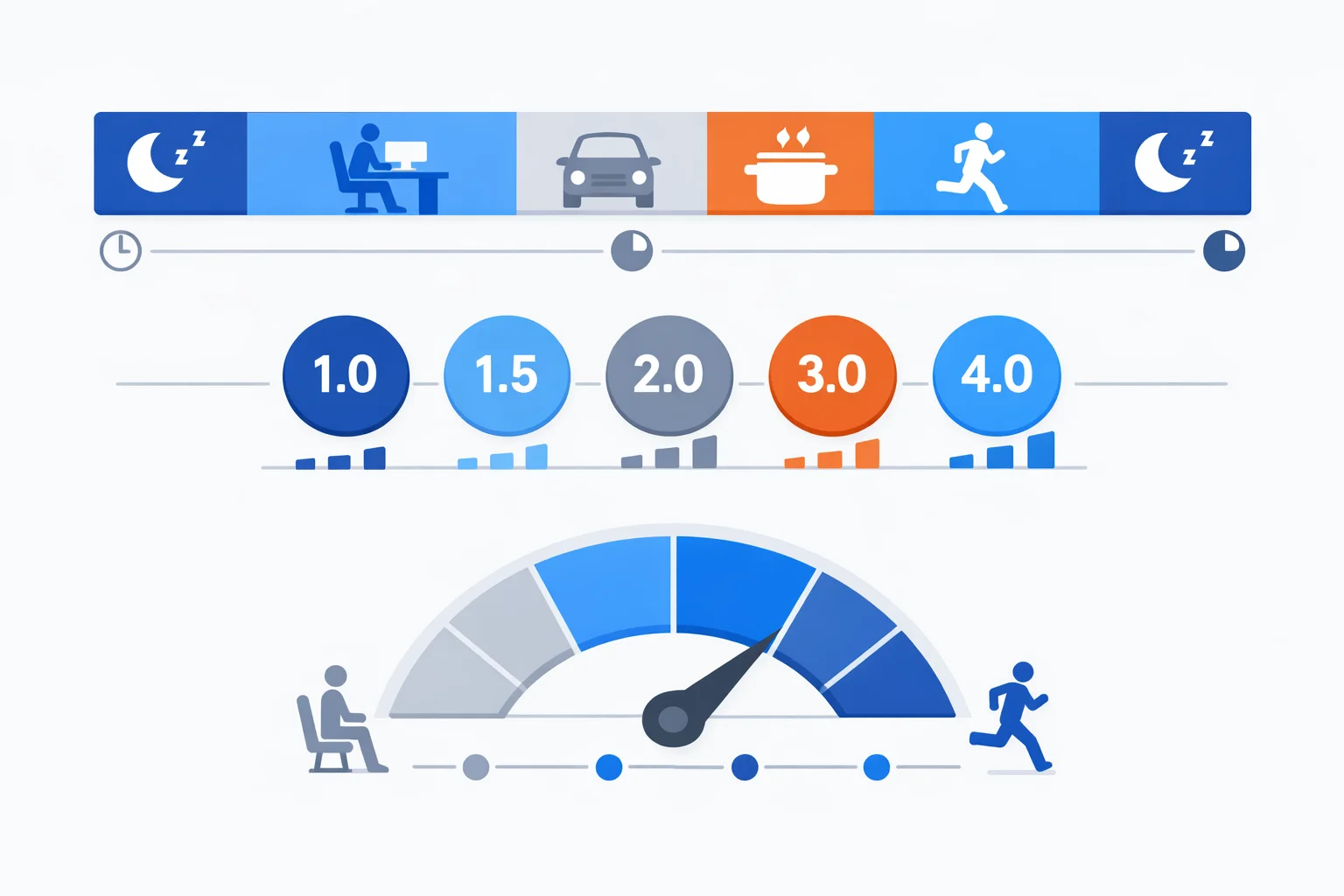
The PAL Ratio, Explained Without the Jargon
PAL is the ratio of your Total Daily Energy Expenditure (TDEE) to your Basal Metabolic Rate (BMR). If your body burns 1,600 kcal just existing — heart beating, lungs breathing, cells dividing — and you actually burn 2,720 kcal in a full day, your PAL is 2,720 ÷ 1,600 = 1.70. That means your daily activities add 70% more energy demand on top of what your body needs at complete rest.
The concept comes from the FAO/WHO/UNU, which needed a standardized way to estimate the caloric needs of entire populations. Instead of measuring every individual with expensive lab equipment, researchers realized they could break a typical day into activity blocks, assign each an energy cost multiplier, and compute a weighted average. That weighted average is PAL.
PAR Values: The Building Blocks of Your Daily PAL
Each activity in your day gets assigned a Physical Activity Ratio (PAR). Don't confuse this with MET values — they're related but not identical. PAR expresses energy cost relative to BMR, while MET expresses it relative to resting metabolic rate (which is slightly different). In practice, PAR and MET values are close enough that the terms get used interchangeably in casual conversation, but technically your PAR for sleeping is 1.0 (equal to BMR), while sitting quietly is about 1.2.
Here's what surprised me when I first saw the PAR data: the difference between sitting at a desk and standing at a desk is only 0.3 PAR units. That standing desk you bought? It burns maybe 15 extra calories per hour for a 70 kg person. Over an 8-hour workday, that's about 120 calories — less than a banana. Standing desks have real postural benefits, but the calorie-burning claims are wildly oversold.
For a quick reference, if you want to understand how individual exercises burn calories through MET values, check out the calories burned calculator which lets you drill into specific activities.
Calculating PAL Step by Step
The formula is straightforward once you see it:
PAL = (PAR1 × hours1 + PAR2 × hours2 + ... + PARn × hoursn) ÷ 24
You multiply each activity's PAR value by the number of hours you spend doing it, sum everything up, then divide by 24. The critical constraint: the hours must total exactly 24. Every minute of your day needs to be accounted for, including sleep, meals, commuting, and the 45 minutes you spent scrolling your phone before bed (that's a PAR of 1.2, by the way).
Let's walk through a concrete example. Say you sleep 8 hours (PAR 1.0), commute 1 hour (PAR 1.5), sit at a desk for 8 hours (PAR 1.5), cook dinner for 1 hour (PAR 2.1), walk the dog for 1 hour (PAR 2.5), watch TV for 3 hours (PAR 1.2), and do personal care for 2 hours (PAR 2.3).
PAL = (1.0 × 8 + 1.5 × 1 + 1.5 × 8 + 2.1 × 1 + 2.5 × 1 + 1.2 × 3 + 2.3 × 2) ÷ 24 = 34.0 ÷ 24 = 1.42
That's a low-active lifestyle, barely above the sedentary threshold. And this person walks their dog every single day. That's the uncomfortable truth the PAL calculation reveals — most people overestimate how active their day actually is.
WHO/FAO Activity Level Classifications
The World Health Organization groups PAL values into categories for population-level nutrition planning. These thresholds aren't arbitrary — they correspond to measurable differences in energy requirements and health outcomes:
- Sedentary (PAL 1.20 – 1.39): Bedridden or wheelchair-bound individuals. Healthy adults rarely fall this low unless they're on complete bed rest.
- Low Active (PAL 1.40 – 1.54): Office workers with no regular exercise. This describes the majority of desk-job adults in developed countries.
- Lightly Active (PAL 1.55 – 1.69): Office work plus some daily walking or light exercise. The minimum recommended by WHO for long-term health.
- Moderately Active (PAL 1.70 – 1.99): Physically demanding job or daily structured exercise of 60+ minutes. Think teachers who stand all day plus an evening workout.
- Vigorously Active (PAL 2.00 – 2.39): Heavy manual labor or competitive athletics with daily training.
- Extremely Active (PAL 2.40+): Professional endurance athletes in peak training. Sustained values above 2.5 are physiologically unsustainable.
Worked Example: Office Worker vs. Construction Worker
Take two 30-year-old males, both 80 kg and 178 cm tall. Their BMR (Mifflin-St Jeor) is identical: roughly 1,780 kcal/day. But their days look completely different.
The Office Worker: Sleeps 7h (1.0), showers/dresses 1h (2.3), drives to work 1h (1.5), desk work 8h (1.5), lunch at desk 1h (1.5), drives home 1h (1.5), cooks dinner 1h (2.1), TV 3h (1.2), phone in bed 1h (1.2). PAL = (7 + 2.3 + 1.5 + 12 + 1.5 + 1.5 + 2.1 + 3.6 + 1.2) ÷ 24 = 32.7 ÷ 24 = 1.36. TDEE = 1,780 × 1.36 = 2,421 kcal.
The Construction Worker: Sleeps 8h (1.0), showers/dresses 1h (2.3), drives to site 0.5h (1.5), heavy labor 8h (6.5), lunch break 1h (1.5), drives home 0.5h (1.5), cooks 1h (2.1), TV 2h (1.2), personal care 2h (2.3). PAL = (8 + 2.3 + 0.75 + 52 + 1.5 + 0.75 + 2.1 + 2.4 + 4.6) ÷ 24 = 74.4 ÷ 24 = 3.10. Actually, let me recalculate that — 8 hours at PAR 6.5 is unusually high. A more realistic PAR for mixed construction tasks is about 4.0, which gives PAL = 1.98. TDEE = 1,780 × 1.98 = 3,524 kcal.
Same body, same BMR, but the construction worker needs 1,100 more calories per day. That's an entire extra meal — and if he doesn't eat it, he'll lose roughly a pound every three days.
From PAL to Calories: The TDEE Connection
Once you know your PAL, getting your Total Daily Energy Expenditure is just one multiplication: TDEE = BMR × PAL. This calculator uses the Mifflin-St Jeor equation for BMR, which is considered the most accurate predictive equation for adults without obesity. For context, if you're curious about the physics behind energy and work, the work calculator covers the mechanical side of energy transfer.
Why does this matter for weight management? Because TDEE is your maintenance line. Eat above it consistently and you gain weight. Eat below it and you lose weight. A 500 kcal daily deficit produces roughly 1 pound of fat loss per week. Knowing your TDEE from PAL — rather than guessing from a dropdown menu — can be the difference between an effective plan and months of frustration. That said, if you want a quick starting estimate without logging 24 hours of activities, our activity level multiplier calculator gives you a ballpark TDEE from just a general lifestyle bracket.
Three Mistakes That Wreck Your PAL Estimate
Mistake #1: Forgetting transition time.People log their 1-hour gym session but forget the 15 minutes of driving each way, 10 minutes of changing clothes, and 5 minutes of chatting. Those 45 "invisible" minutes at PAR 1.5 dilute what looked like an intense workout block.
Mistake #2: Overestimating exercise intensity.Running a 10-minute mile gets a PAR around 7.0. But most "running" sessions include warm-up walking, water breaks, and cool-down. The effective PAR for a typical 45-minute "run" might be closer to 5.0 when averaged honestly.
Mistake #3: Ignoring the other 22 hours.An incredible workout means almost nothing to your PAL if the rest of your day is spent sitting. One hour at PAR 7.0 and 15 hours at PAR 1.3 still gives you a PAL of about 1.55. The math is brutal: your non-exercise hours dominate the average. This is exactly why NEAT (Non-Exercise Activity Thermogenesis) research has become so important — the fidgeting, walking, standing, and puttering you do between workouts matters more than the workout itself for overall daily energy expenditure.
Practical Ways to Raise Your PAL Without a Gym
Since your PAL is a 24-hour weighted average, small changes across many hours beat one big workout. Walking during phone calls (PAR 2.5 vs. 1.2 sitting) for just 2 hours per day shifts your PAL by about 0.11 — enough to move from "low active" to "lightly active." Cooking instead of ordering delivery swaps 1 hour at PAR 1.2 (eating on the couch) for PAR 2.1, and you get a healthier meal as a bonus.
If you want to see how military fitness standards translate to high PAL values, the Marine Corps PFT calculatorshows what it takes to score at the competitive end of physical readiness — those service members typically carry PAL values above 2.0.
The most effective strategy I've seen is what researchers call "activity snacking" — breaking up long sedentary blocks with 5-10 minute movement bursts. Eight hours of desk work with a 5-minute walk every hour turns PAR 1.5 into an effective PAR of about 1.65 for that block. It doesn't sound like much, but over 8 hours, that shift alone adds roughly 100 calories of expenditure and, more importantly, reduces the metabolic risks associated with prolonged sitting.