Marine Corps PFT Scoring Explained: What Every Marine and Recruit Needs to Know
Somewhere right now, a Lance Corporal is Googling "marine corps physical fitness test calculator" at 2 AM because their PFT is next week and they can't figure out whether 18 pull-ups puts them at first class. The scoring isn't intuitive — it shifts by age, gender, and which upper body event you pick. This guide breaks down exactly how every point is calculated so you can walk into your next PFT knowing your score before you even start.
Three Events, One Score: How the PFT Works
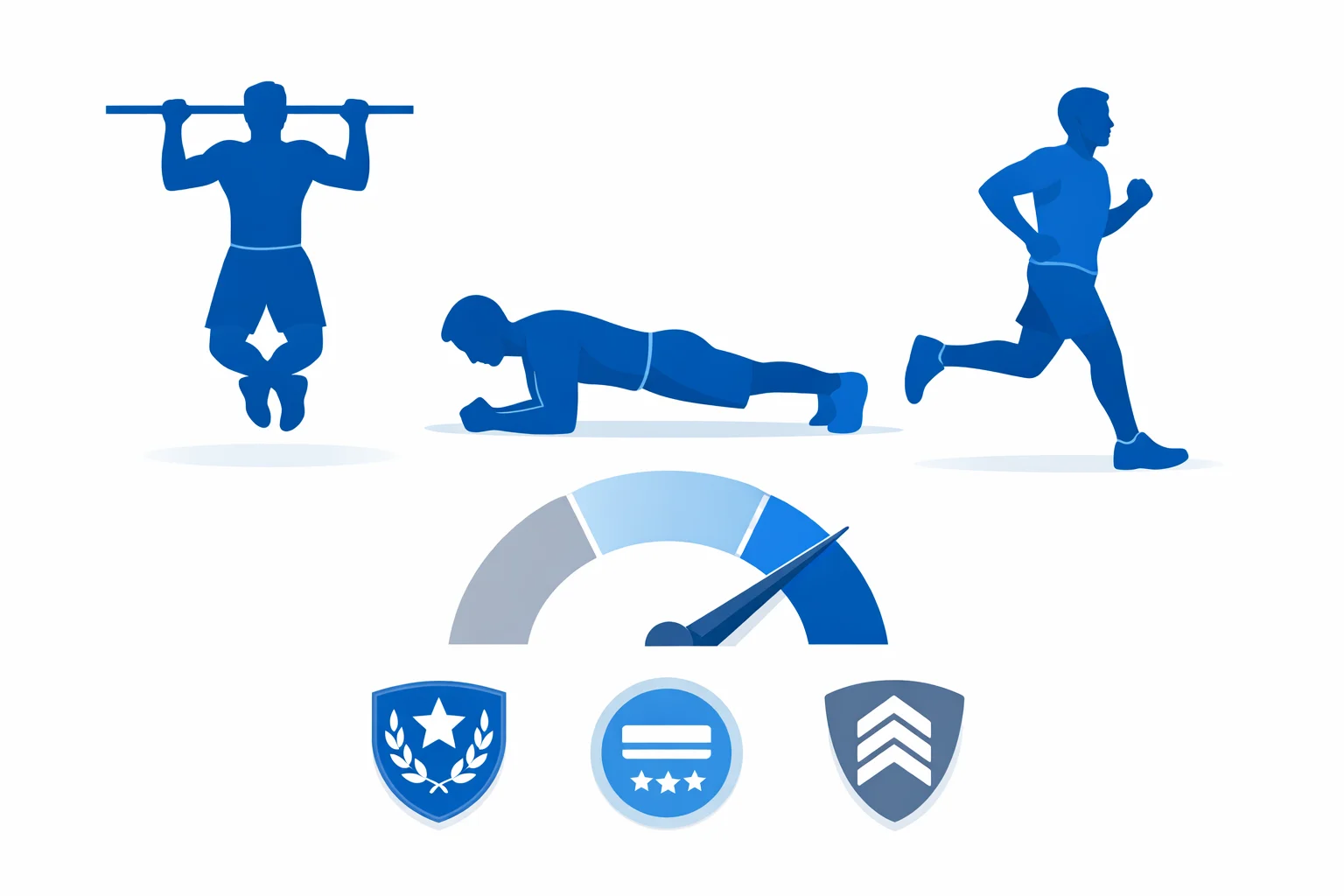
The Marine Corps PFT consists of three events: an upper body exercise (pull-ups or push-ups), a plank hold, and a 3-mile run. Each event is scored from 0 to 100 points, giving you a maximum possible score of 300. Simple enough — except push-ups cap at 70, not 100, so choosing them drops your ceiling to 270.
You need a minimum of 40 points on eachevent and at least 150 total to pass. Score below 40 on any single event and it doesn't matter how fast you ran — you fail the entire test. That 40-point minimum is the number that catches people off guard. A Marine who can do 22 pull-ups and run an 18-minute three-miler will still fail if their plank gives out at 55 seconds.
Pull-ups vs. Push-ups: The 30-Point Tradeoff
Here's the decision that defines your PFT ceiling. Pull-ups can earn you the full 100 points. Push-ups max out at 70 — no matter how many you crank out, you can't get past 70. That's a 30-point gap that makes first class nearly impossible on push-ups alone.
For males aged 21-25, the pull-up scoring works out to roughly 3.3 points per rep. You need 5 pull-ups for the minimum 40 points and 23 for a perfect 100. Females in the same age group need just 1 pull-up for 40 points and 11 for the max. The scaling is linear between those anchors, which means every single rep matters equally — there's no diminishing return.
Push-ups follow the same linear logic, but compressed into a 40-to-70 range. A 21-25 year old male needs 40 push-ups for 40 points and 87 for the capped 70. That's 47 extra reps for just 30 points. The math makes the choice obvious for anyone who can do more than a handful of pull-ups.
The Plank Replaced Crunches — Here's What Changed
As of 2023, crunches are gone. The forearm plank is now the only abdominal event on the PFT. You hold a standard forearm plank position for as long as you can, and the clock determines your score. The thresholds are the same regardless of age or gender: 1 minute 10 seconds earns 40 points, and 3 minutes 45 seconds earns the full 100.
The switch actually simplified things. No more counting reps, no more arguing with the counter about whether your shoulders touched the mat. Just hold position, hold form, hold time. But 3:45 is no joke — most recreational gym-goers tap out around 2 minutes. If you're scoring 80+ on the plank, you're doing real core work, not just existing in a position.
3-Mile Run Scoring by Age and Gender
The run is where age and gender adjustments make the biggest difference. A 22-year-old male needs to finish in 18:00 for a perfect 100 and has until 27:40 before hitting the 40-point floor. A 50-year-old male gets 19:30 for the same 100 points and the floor extends to 30:00. Female Marines get additional time across all age groups — a 22-year-old female runs 21:00 for a perfect score with a floor at 30:50.
Between those anchors, scoring is linear. For a 21-25 male, every 5.8 seconds faster earns roughly one more point. So shaving 30 seconds off your run adds about 5 points to your total — often enough to jump a classification tier. That's why the run is where most Marines focus their training when they need to move their score.
Worked Example: Calculating a Full PFT Score
Let's score a real PFT. Corporal Davis, male, age 24, posts these numbers:
- Pull-ups: 18 reps
- Plank: 3:15 (195 seconds)
- 3-mile run: 21:30 (1,290 seconds)
Pull-up score: Age group 21-25 males need 5 reps for 40 points and 23 for 100. Cpl Davis did 18, which is 13 reps above the minimum out of an 18-rep range. Score = 40 + (13/18 × 60) = 40 + 43 = 83 points.
Plank score: The minimum is 70 seconds (40 pts) and max is 225 seconds (100 pts). At 195 seconds, he's 125 seconds above the floor across a 155-second range. Score = 40 + (125/155 × 60) = 40 + 48 = 88 points.
Run score: For 21-25 males, 1,080 seconds (18:00) = 100 pts and 1,660 seconds (27:40) = 40 pts. At 1,290 seconds, he's 210 seconds slower than perfect across a 580-second range. Score = 100 − (210/580 × 60) = 100 − 22 = 78 points.
Total: 83 + 88 + 78 = 249.That's a solid 1st Class PFT. If Cpl Davis had chosen push-ups instead and scored 70 (the max), his total would drop to 236 — barely 1st Class. Those 13 extra pull-up points above the push-up cap kept him comfortable.
What Score Do You Actually Need?
Technically, 150 is passing. Practically, anything under 200 will stall your career. Here's what the numbers mean in real terms:
- 235-300 (1st Class): Expected for NCOs and anyone looking at competitive billets. Required for some MOS school selections and special duty assignments.
- 200-234 (2nd Class): Meets the standard. You won't get flagged, but you won't stand out on promotion boards either.
- 150-199 (3rd Class): Passing, but barely. You'll likely hear from your chain of command and get assigned to remedial PT.
- Below 150: Failure. Remedial program, potential adverse action with repeated failures.
For Marines in combat arms specialties, a 2026 policy update requires sex-neutral PFT minimums using male age-normed standards with a minimum score of 210 points (70% of the max 300).
Mistakes That Cost Marines Points on Test Day
The most expensive mistake isn't poor fitness — it's bad pacing. Marines who sprint the first mile of their 3-mile run routinely blow up on mile three and lose 15-20 points compared to what even splits would have earned them. If your goal time is 21:00, run 7:00 miles, not 6:15 then 7:00 then 7:45.
- Kipping pull-ups. Your rep won't count if the monitor calls it. Strict dead-hang pull-ups only — chin clearly above the bar, full arm extension at the bottom. Losing 2 no-counted reps costs you roughly 10 points.
- Plank hip sag. The moment your hips drop below the plane of your shoulders and ankles, the monitor gives you a warning. Multiple warnings and you're done. Practice holding form at 4 minutes in training so 3:45 feels manageable on test day.
- Choosing push-ups "just in case." Some Marines default to push-ups as a safety net. But if you can do 5+ pull-ups, you'll almost certainly score higher by choosing them — even 10 pull-ups already ties the push-up ceiling of 70 for a 21-25 male.
How to Add 30 Points to Your PFT in 8 Weeks
Thirty points spread across three events is 10 per event — that's about 2 extra pull-ups, 25 more seconds on the plank, and 60 seconds off the run. All achievable in 8 weeks with focused training.
Pull-ups: Grease the groove. Do 50-60% of your max 5-6 times throughout the day, every day. If your max is 12, do sets of 6-7 scattered across the day. By week 8, your max will be 15-16 without ever training to failure.
Plank: Hold three planks per session — one at 80% of your max time, one at 100%, and one at 80% again. Do this 4 times a week. Your max will climb 15-20 seconds per week. Also train side planks and plank shoulder taps to build the stability muscles that give out first.
Run: Two interval sessions and one long run per week. Intervals: 6×800m at your target per-mile pace with 90 seconds rest. Long run: 4-5 miles at conversational pace. Use our calories burned calculator to estimate energy expenditure for these training sessions. To make sure you're fueling properly across your entire training day — not just the workout — the PAL calculator can estimate your total daily energy needs based on all 24 hours of activity.
Marine PFT vs. Other Military Branch Fitness Tests
The Marine PFT stands apart from other branches primarily because of pull-ups and the 3-mile run distance. Here's how they compare:
| Branch | Upper Body | Core | Cardio | Max Score |
|---|---|---|---|---|
| Marines (PFT) | Pull-ups or push-ups | Plank | 3-mile run | 300 |
| Army (ACFT) | Hex bar deadlift + hand-release push-ups | Plank | 2-mile run + sprint-drag-carry | 600 |
| Navy (PRT) | Push-ups | Forearm plank | 1.5-mile run, row, or swim | 300 |
| Air Force (PFA) | Push-ups | Sit-ups | 1.5-mile run | 100 |
The Marine 3-mile run is double the Air Force's 1.5-mile standard and 50% longer than the Army's 2-mile run. If you're comparing scores across branches, our Army APFT calculator uses the same per-event scoring approach but with different events and thresholds. The Air Force PFA calculator uses a 100-point composite scale weighted heavily toward the run — a very different philosophy from the Marine PFT's equal-weight approach. The Navy PRTis the closest sibling — same 300-point scale and a plank event — but uses a category-based system where your lowest event caps your overall rating. And pull-ups test a different kind of strength than push-ups — you can't muscle through reps on pull-ups with poor form the way some people do with push-ups.