How the Army APFT Scoring System Works — And Why Every Point Matters
An army APFT calculator does one thing that the paper scoring charts can't — it shows you exactly how close you are to the next threshold. The Army Physical Fitness Test scored three events (push-ups, sit-ups, and a 2-mile run), each worth up to 100 points, for a maximum of 300. The math behind it isn't complicated, but the tables shift across nine age groups and two genders, which makes mental math unreliable when you're trying to figure out whether 48 push-ups at age 28 gets you to 70 points or 72.
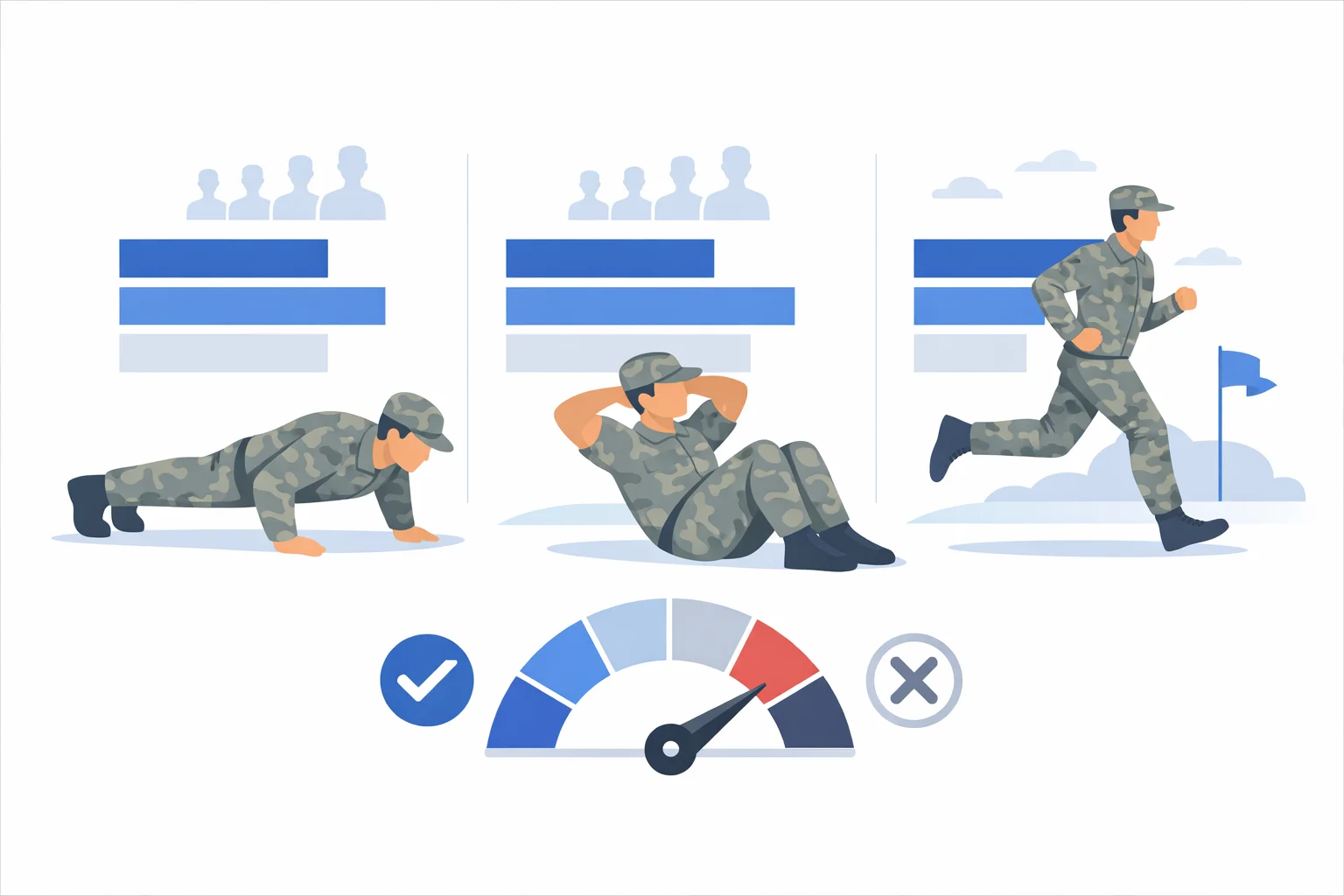
Three Events, 300 Points: The APFT Structure
The APFT was the Army's standard physical fitness assessment from 1980 until the ACFT replaced it in 2022. It tested three events in a fixed order: push-ups for two minutes, sit-ups for two minutes, then a 2-mile run. Each event scored 0 to 100 points. You needed a minimum of 60 per event to pass — fall below that on any one event and the entire test was a failure, regardless of your other scores.
That per-event minimum is what tripped people up. A soldier who cranked out 80 push-ups and ran 13:30 would still fail if they only managed 40 sit-ups. The APFT wasn't about being strong in one area — it tested baseline competence across all three fitness domains.
Push-up Scoring: Where Most Points Are Won or Lost
Push-ups are the event with the widest performance spread. For a 22-26 year old male, you need 40 push-ups just to hit 60 points (the passing floor) and 75 to max at 100. That's a 35-rep window covering 40 points, which works out to roughly 1.14 points per push-up. Every single rep counts — there's no plateau in the scoring curve.
Female standards reflect a different physiological baseline. A 22-26 year old female needs 17 push-ups for 60 points and 46 for a max. The per-rep point value is nearly identical to the male scale, which means the test rewards effort proportionally within each standard. What throws people off is the age adjustment: a 47-51 year old male only needs 25 push-ups to pass, down from 40. That's a 37.5% reduction, reflecting genuine age-related strength decline.
Sit-ups — The Event Everyone Underestimates
Here's where APFT scoring gets slightly deceptive. The sit-up standards don't differ by gender for most age groups — a 22-26 year old male and female both need 50 sit-ups to score 60 points and 80 for a perfect 100. The sit-up is the "equalizer event," and it's the one soldiers tend to neglect in training because push-ups and running feel more obviously important.
That neglect costs points. Sit-up technique matters more than raw core strength — the two-minute window rewards rhythm and pacing, not just how hard you can contract your abs. A common pattern: soldiers blast through the first 40 reps in 50 seconds, gas out, and struggle to hit 55 total. The soldiers who max the event rarely look explosive. They find a steady cadence of about 25-27 reps per minute and hold it. Boring? Yes. Effective? Completely.
2-Mile Run: Time Converts to Points, Not Pace
The 2-mile run is straightforward: start, finish, read the clock. For a 22-26 year old male, 13:00 flat earns 100 points and 16:36 is the minimum 60. Between those anchors, every 5.4 seconds translates to approximately one point. For the same age group in females, 100 points requires a 15:42 finish and 60 points means 19:56.
What surprises people is how the age adjustments work. A 42-46 year old male gets 100 points for a 14:30 run — only 90 seconds slower than a 22-year-old's max. But the 60-point threshold extends to 19:30, giving a full 3-minute cushion on the passing end. The Army's age tables compress the top end (maxing barely gets easier) while expanding the bottom (passing gets significantly easier). This means older soldiers who are "just passing" benefit enormously from the age curve, but those chasing a max score don't get much relief.
Worked Example: Scoring a Complete APFT
Specialist Torres, female, age 29, records these results:
- Push-ups: 38 reps in 2 minutes
- Sit-ups: 62 reps in 2 minutes
- 2-mile run: 17:45 (1,065 seconds)
Push-up score: Age group 27-31 females need 17 reps for 60 points and 50 for 100. SPC Torres did 38, which is 21 reps above the minimum across a 33-rep range. Score = 60 + (21/33 × 40) = 60 + 25 = 85 points.
Sit-up score: For the 27-31 group, 45 reps = 60 points and 82 reps = 100. At 62 reps, she's 17 above the floor across a 37-rep range. Score = 60 + (17/37 × 40) = 60 + 18 = 78 points.
Run score: Female 27-31: 972 seconds (16:12) = 100 points, 1,236 seconds (20:36) = 60 points. At 1,065 seconds (17:45), she's 93 seconds past max across a 264-second range. Score = 100 − (93/264 × 40) = 100 − 14 = 86 points.
Total: 85 + 78 + 86 = 249.That's solidly in "Very Good" territory. Her weakest event is sit-ups — adding just 8 more reps would push that score above 85 and put her total past 256. Small targeted improvement, big composite payoff.
APFT vs. ACFT — What Changed and What Didn't
The Army Combat Fitness Test replaced the APFT in October 2022 with six events instead of three: a 3-repetition maximum deadlift, standing power throw, hand-release push-ups, sprint-drag-carry, leg tuck (or plank), and a 2-mile run. The run survived. Everything else changed. The ACFT was designed to test combat-relevant fitness — explosive strength, anaerobic capacity, and loaded movement — rather than muscular endurance alone.
But the APFT scoring tables haven't disappeared. ROTC programs still reference them. National Guard and Reserve units used them through transition periods. And plenty of soldiers keep tracking their APFT scores informally because three decades of institutional muscle memory doesn't vanish overnight. If you're comparing fitness across eras — "my sergeant scored 290 back in 2015" — you're talking APFT. For a side-by-side with another branch's current test, check our Marine Corps PFT calculator or the Air Force PFA calculator, which uses a completely different 100-point composite system.
The Physical Fitness Badge and Why 90+ Matters
Scoring 90 or higher on all three events didn't just earn you bragging rights — it qualified you for the Army Physical Fitness Badge, a cloth badge worn on the physical fitness uniform. More practically, an "extended scale" APFT score carried weight on promotion boards and selection packets for schools like Ranger School, Airborne, and Special Forces Assessment and Selection.
The distinction between 89 and 90 on a single event was career-relevant. A soldier with a 269 total (89/90/90) couldn't claim the badge. One more push-up or two seconds off the run would've changed that. This is exactly the kind of threshold analysis that makes using a calculator worth the 30 seconds of data entry — you can see precisely how close you are to a meaningful cutoff. For the physics behind how your body generates mechanical power during timed events, the relationship between force, distance, and time applies directly.
Five Mistakes That Drop Your APFT Score
After watching hundreds of APFTs, these are the patterns that cost soldiers 10-30 points they should've had:
- Going out too fast on push-ups. Burning through 30 reps in 40 seconds feels great until muscle failure hits at rep 42 with a minute still on the clock. Pacing at 20-22 reps per 30-second block typically yields more total reps.
- Not locking elbows. The grader doesn't count the rep if your arms don't fully extend. Five "no-count" reps at the end when fatigue sets in erases 5-6 points you already earned.
- Neglecting sit-up technique. Soldiers who anchor their feet too far away or too close waste energy on hip flexor compensation. The optimal foot placement keeps your heels roughly 12-15 inches from your glutes.
- Starting the run too aggressively. Running the first quarter-mile at a 6:00/mile pace when your target is 7:30/mile guarantees a painful second mile. Negative splits (second mile faster than the first) almost always produce better times.
- Ignoring hydration timing. Drinking a liter of water 10 minutes before the run guarantees side stitches. Hydrate the day before and sip — don't gulp — in the hours leading up to the test.
Raising Your Score: Where to Focus First
If your total score is below 240, the fastest path to improvement almost always runs through your weakest event. The APFT's linear scoring means adding 5 reps to a 45-push-up baseline earns the same points as adding 5 reps to a 65-push-up baseline. There's no diminishing return — every rep pays the same rate.
That said, the run usually offers the highest return on training investment for soldiers who aren't already running regularly. Going from a 17:00 to a 16:00 two-miler is achievable in 6-8 weeks of structured interval training and earns you roughly 10 additional points. Achieving the equivalent push-up improvement (about 12 extra reps) typically takes longer because upper body strength adaptation is slower than cardiovascular improvement. The physics analogy is clear — understanding the work your body performs per rep helps you think about training efficiency the same way engineers think about mechanical systems.
One more strategy that's underused: practice under test conditions. Do a full mock APFT — push-ups, rest 10 minutes, sit-ups, rest 10 minutes, run — at least once every two weeks during your training cycle. Test-day pacing is a skill, and you can only build it by simulating the actual event sequence and fatigue accumulation. If you're also tracking calorie expenditure during training sessions, our calories burned calculator can help you estimate energy cost by activity and duration so you fuel properly for test day.