USAF Physical Fitness Assessment Scoring: The Complete Breakdown for Every Airman
Every Air Force physical fitness test calculator you'll find online spits out a number. What most of them don't tell you is whythat number matters — and more specifically, which of the three components gives you the biggest lever to move it. The USAF Physical Fitness Assessment uses a 100-point composite scale that's weighted heavily toward the run, and that weighting is the single most important thing to understand before your next test.
How the Air Force PFA Scoring Actually Works
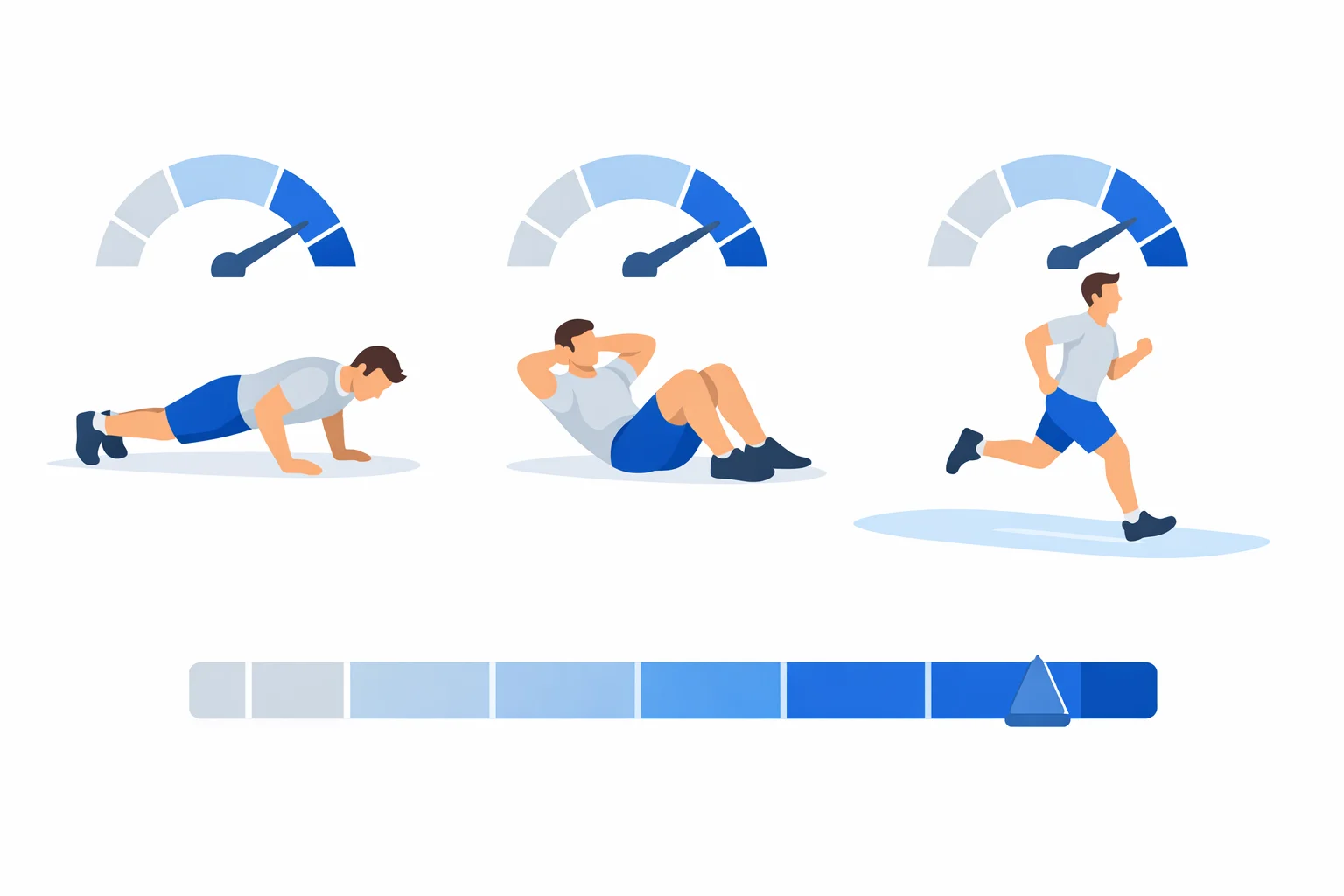
The PFA divides 100 points across three components: the 1.5-mile run gets 60 points, push-ups get 20, and sit-ups get 20. That split looks lopsided because it is. The Air Force values cardiovascular endurance three times more than muscular fitness in each individual component. You can max both muscular events and still only have 40 points — barely over halfway to the 75 you need to pass.
Each component has its own minimum. You need at least 10 points on each one, and falling below that threshold on any single componentfails the entire test regardless of your composite total. So a 58-point run with 20 on push-ups and 20 on sit-ups gives you 98 — technically excellent. But if your push-ups scored 9 instead of 10, you fail. The per-component minimums are the tripwire most Airmen don't worry about until it's too late.
The 1.5-Mile Run Is 60% of Your Score
This isn't hyperbole. The run is worth 60 out of 100 points, making it by far the most consequential event on any military fitness test across all branches. For a male under 25, a 9:12 finish earns the full 60 points and 13:36 is the floor at 10 points. Between those anchors, every 5.3 seconds faster adds roughly one point to your score. Think about that — shaving 30 seconds off your run adds about 5-6 composite points, which is the equivalent of adding 8-10 extra push-ups.
Female run standards are adjusted but follow the same linear pattern. A female under 25 maxes at 10:23 and the minimum is 16:22. Older age groups get progressively more time — a male 50-54 can run 12:12 for a max score, gaining nearly 3 full minutes compared to the under-25 standard. The age curves are generous on the run, which is why many experienced Airmen actually find the test easier in their 40s than they expected.
Push-up Standards: One Minute, Twenty Points
The Air Force gives you exactly 60 seconds for push-ups — half the time the Army allows for the same exercise. That compression changes the entire strategy. You can't afford a slow warm-up rep or a 5-second breather at rep 30 the way you might with a 2-minute window. Every second counts.
For a male aged 25-29, the minimum passing threshold (10 points) requires 30 push-ups and a perfect 20 points requires 64. That's a 34-rep window spanning 10 points, or roughly 0.29 points per push-up. Contrast that with the run, where every second is worth about 0.19 points — push-ups actually have a higher per-unit point value, but the ceiling is only 20 instead of 60. It's a sprint within a sprint: maximize reps in minimal time for a modest but meaningful chunk of your composite.
Sit-up Scoring and Why Cadence Beats Speed
Sit-ups mirror the push-up structure — 1 minute, 20 points max, same 10-point minimum. But the rep counts are different. A male under 25 needs 42 sit-ups for the minimum and 58 for a perfect score. That's only a 16-rep window, which makes the scoring sharper: each sit-up above the minimum is worth roughly 0.625 points. Missing 4 sit-ups near the top end costs you 2.5 composite points — enough to bump you from 89 to 87 and cost you the Excellent rating.
The trick with sit-ups isn't raw abdominal strength. It's rhythm. Find a sustainable cadence — about one rep per second — and hold it for 60 seconds. Airmen who start at 1.5 reps per second invariably crash around the 35-second mark and lose 5-8 reps they would've gotten with a steadier pace. Metronome-style consistency beats explosive effort every time on timed calisthenic events.
Worked Example: Scoring a Complete PFA
Staff Sergeant Chen, male, age 31, posts these results:
- Push-ups: 48 reps in 1 minute
- Sit-ups: 44 reps in 1 minute
- 1.5-mile run: 11:15 (675 seconds)
Push-up score: Age group 30-34 males need 27 reps for 10 points and 60 for 20. SSgt Chen did 48, which is 21 reps above the minimum across a 33-rep range. Score = 10 + (21/33 × 10) = 10 + 6 = 16 points.
Sit-up score: Same age group needs 36 reps for 10 points and 52 for 20. At 44 reps, he's 8 above the floor across a 16-rep range. Score = 10 + (8/16 × 10) = 10 + 5 = 15 points.
Run score: Male 30-34: 600 seconds (10:00) = 60 points, 876 seconds (14:36) = 10 points. At 675 seconds (11:15), he's 75 seconds past max across a 276-second range. Score = 60 − (75/276 × 50) = 60 − 14 = 46 points.
Composite: 16 + 15 + 46 = 77.Satisfactory — he passes, but he's 13 points short of Excellent. His weakest component relative to its maximum is the run (46/60 = 77%) versus push-ups (16/20 = 80%) and sit-ups (15/20 = 75%). But because the run is worth triple, improving his run by 40 seconds would add about 7 points, while maxing sit-ups would only add 5. The run is always the priority when chasing Excellent.
Why the Waist Measurement Got Removed
Before 2023, the PFA included a fourth component: waist circumference, worth 20 points. The run was worth 60, push-ups 10, sit-ups 10, and waist 20. This meant an Airman with a 35-inch waist and average fitness could fail the test entirely based on body composition, even if they ran a strong 1.5 miles and maxed both muscular events.
The Air Force removed the waist measurement after internal studies showed it penalized muscular Airmen — particularly those in career fields requiring physical strength — and didn't reliably predict fitness or health outcomes better than the existing run component. The 20 waist points got redistributed to push-ups and sit-ups (each jumping from 10 to 20 points), giving the muscular components more weight in the composite. That redistribution is significant: an Airman who maxes push-ups and sit-ups now earns 40 points from those events, compared to just 20 before.
Excellent vs. Satisfactory — What the Ratings Actually Mean
The Air Force uses only two passing tiers. Score 90-100 and you're Excellent. Score 75-89 and you're Satisfactory. Below 75 (or below 10 on any component) is Unsatisfactory — a failure. There's no Good, Very Good, or First Class like other branches use. It's binary: you either hit Excellent or you didn't.
That binary matters because of test frequency. Excellent Airmen test once per year. Satisfactory Airmen test every six months. Over a 20-year career, the difference between 89 and 90 means roughly 20 fewer fitness tests — that's 20 fewer preparation cycles, 20 fewer days of test-day stress, and a noticeably different experience of military fitness culture. The Army APFTused more granular tiers (Pass, Good, Very Good, Excellent), but the Air Force's blunt two-tier system creates a clearer incentive: get above 90 or accept twice the testing burden.
Four Mistakes That Tank Your PFA Score
After reviewing hundreds of PFA results, these patterns consistently separate Airmen who score 85 from those who score 92:
- Training cardio but ignoring the run pace. An Airman who runs 3-5 miles at a comfortable pace three times a week will improve general fitness but won't necessarily improve their 1.5-mile time. The PFA run is a near-sprint for most people. You need speed work — 400m and 800m intervals at your target mile pace — to actually move your score. Slow long runs build a base; intervals build the speed that earns points.
- Resting during the muscular events. You have 60 seconds. Any rest position (locked arms for push-ups, flat on the ground for sit-ups) burns clock without earning reps. If you need a break, make it 2-3 seconds, not 8-10. Five seconds of rest at the wrong time costs you 3-4 reps, which is 1-2 composite points.
- Testing without a mock run. Airmen who know their 1.5-mile pace within 10 seconds score consistently higher than those who "feel it out." Run a timed 1.5-mile at least twice in the month before your PFA. Use the split times — if your first lap is 15 seconds faster than your target, you're going out too hard.
- Underestimating the sit-up window. The gap between minimum and maximum on sit-ups is only 16 reps for most age groups. That's a razor-thin margin. Six fewer sit-ups can cost you 3-4 points, and when you're at 88 composite, those points are the difference between Excellent and Satisfactory. Use our calories burned calculator to ensure your training nutrition matches your output if you're training multiple events per session.
Air Force PFA vs. Army, Marine, and Navy Fitness Tests
Here's how the four major branches stack up:
| Branch | Events | Cardio Distance | Max Score | Pass Threshold |
|---|---|---|---|---|
| Air Force (PFA) | Push-ups, sit-ups, run | 1.5 miles | 100 | 75 composite |
| Army (APFT) | Push-ups, sit-ups, run | 2 miles | 300 | 60 per event |
| Marines (PFT) | Pull-ups/push-ups, plank, run | 3 miles | 300 | 150 total + 40/event |
| Navy (PRT) | Push-ups, plank, run/row/swim | 1.5 miles | 300 | Satisfactory per event |
The Air Force run matches the Navy's 1.5-mile distance but is half the Marine Corps' 3-mile standard. Despite the shorter distance, the Air Force run is worth a larger fraction of the total score (60%) than any other branch's cardio component. The Marine PFT distributes points equally across three events at roughly 33% each, making it a more balanced test where a weakness in one event can be offset by strength in another. The Navy PRT calculatorshares the same 1.5-mile run distance as the Air Force but scores it on a 100-point event scale within a 300-point composite — and uniquely offers swimming and rowing as official cardio alternatives. The Air Force system doesn't allow that kind of compensation — a mediocre run sinks you no matter how many push-ups you can crank out.