Mechanical Advantage and Simple Machines: The Physics Behind Force Multiplication
A mechanical advantage calculator in physics answers one of the oldest engineering questions humans have faced: how much less force do I need if I use this tool? Archimedes supposedly said he could move the Earth with a long enough lever — and he wasn't wrong about the math. The concept of mechanical advantage (MA) puts a number on exactly how much force a simple machine multiplies, whether it's a crowbar prying up a nail, a block-and-tackle hoisting a sail, or a car jack lifting two tons of steel with one hand on a wrench.
But here's the part that trips people up: mechanical advantage doesn't create force out of nothing. It's a trade. Every newton of force you save costs you an equivalent distance. A lever with MA = 10 means you push 10 times farther — the work stays the same, but the effort gets spread thinner. Understanding that trade-off is the whole point.
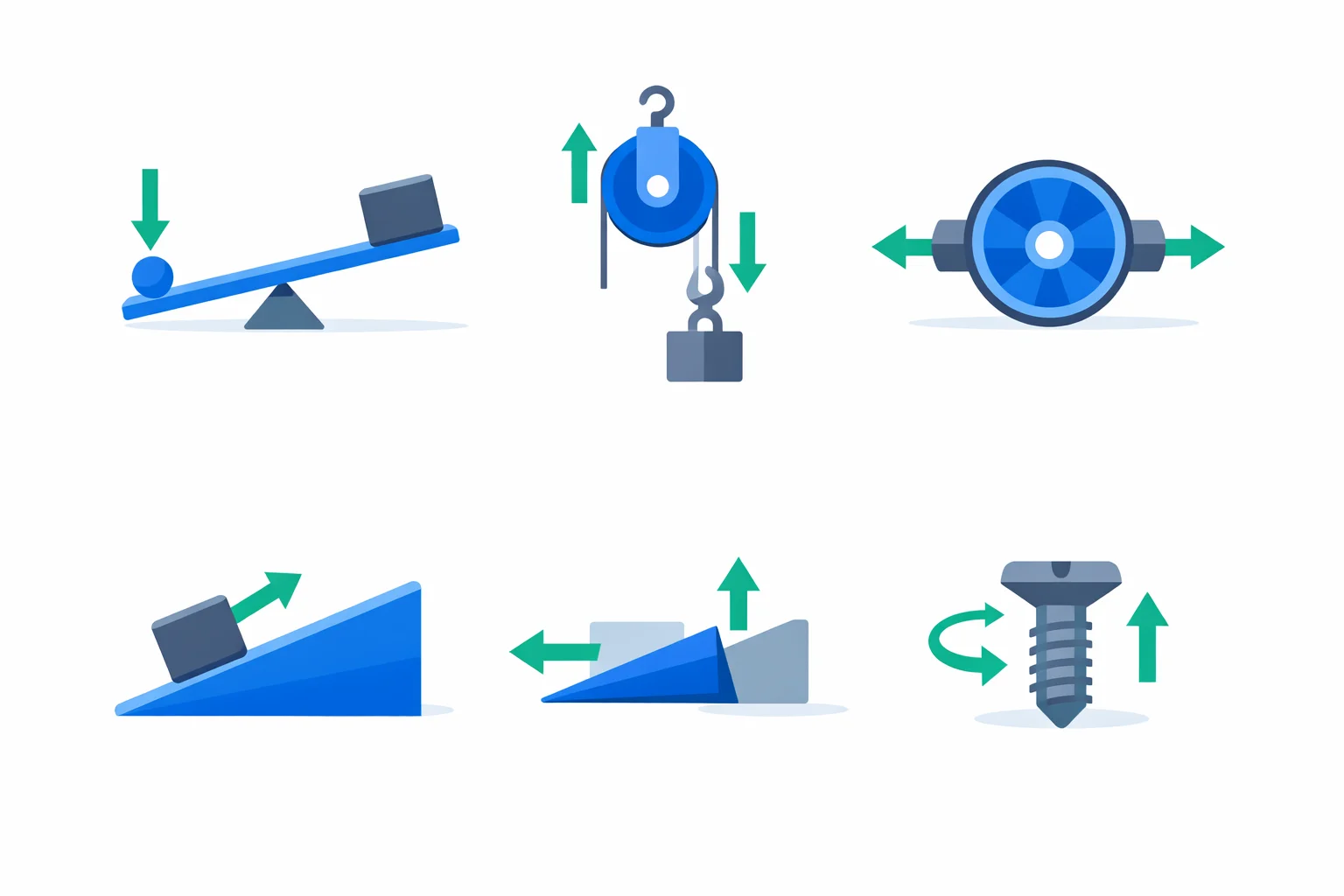
What Mechanical Advantage Actually Means
Mechanical advantage is the ratio of output force to input force for a machine. If you push with 50 N and the machine delivers 200 N to the load, the MA is 4. Simple as that.
There are two flavors. Ideal mechanical advantage (IMA) comes purely from geometry — arm lengths, rope counts, ramp angles — and ignores friction entirely. Actual mechanical advantage (AMA) uses the forces you actually measure in the real world, which are always worse than ideal because friction eats some of your input energy. The ratio of AMA to IMA gives you the machine's efficiency.
The Six Simple Machines and Their MA Formulas
Every complex machine — from a bicycle to a crane — breaks down into combinations of six fundamental simple machines. Each has its own MA formula:
| Machine | IMA Formula | What It Does |
|---|---|---|
| Lever | deffort / dload | Multiplies force (or speed) around a pivot point |
| Pulley | Number of supporting ropes | Redirects and/or multiplies pulling force |
| Inclined Plane | L / h (length / height) | Spreads a vertical lift over a longer, gentler path |
| Wheel & Axle | R / r (wheel radius / axle radius) | Converts rotational distance into amplified torque |
| Wedge | L / w (length / width) | Converts a push into a lateral splitting force |
| Screw | 2πr / pitch | Converts rotation into powerful linear force |
The screw deserves a special mention for sheer force multiplication. A car jack with a 25 cm handle and 5 mm pitch has an IMA of about 314. One full crank of the handle moves the screw just 5 mm — but with 314 times the force you applied. That's how a person can lift a 2-ton car.
Ideal vs. Actual Mechanical Advantage
In a textbook, a frictionless pulley with four supporting ropes has IMA = 4. You pull with 250 N to lift a 1,000 N crate. Clean and easy.
In a real shop, the pulleys have bearing friction, the rope stretches slightly and drags against the sheave, and the block itself has weight. So you might need 310 N instead. Your AMA is 1,000 / 310 = 3.23 — not 4. The efficiency is 3.23 / 4 = 80.6%.
That 20% loss to friction matters. When you calculate the work done on each side, the input work is always greater than the output work. The "missing" energy becomes heat in the rope and axle bearings. No machine escapes this — the second law of thermodynamics sees to that.
Worked Example: Moving a Piano Up a Ramp
A 350 kg upright piano needs to go from a truck bed to a stage that's 1.2 m higher. You have a 4.8 m ramp and three friends.
Step 1: Weight of the piano.W = mg = 350 × 9.81 = 3,433.5 N. That's about 772 lbs of gravitational pull straight down.
Step 2: IMA of the ramp.IMA = L / h = 4.8 / 1.2 = 4. In an ideal world, you'd push with 3,433.5 / 4 = 858.4 N along the ramp surface.
Step 3: Reality check.The ramp has a friction coefficient of about 0.15 against the piano's rubber casters. The friction force adds roughly 350 × 9.81 × cos(14.5°) × 0.15 ≈ 498 N. So the actual push needed is about 858 + 498 = 1,356 N. Split four ways, that's 339 N per person — totally manageable.
Step 4: Efficiency. AMA = 3,433.5 / 1,356 = 2.53. Efficiency = 2.53 / 4 = 63%. About 37% of your pushing energy fights friction instead of lifting the piano. Choosing smoother wheels or a longer ramp would improve this.
Three Classes of Levers — And Why Class Matters
Not every lever multiplies force. There are three classes, and they behave very differently:
First-class: fulcrum between effort and load. A seesaw, a crowbar, scissors. MA depends on arm lengths — it can be greater or less than 1 depending on where the fulcrum sits.
Second-class: load between fulcrum and effort. A wheelbarrow, a bottle opener, a nutcracker. MA is always greater than 1 because the effort arm is always longer than the load arm. These are your pure force multipliers.
Third-class: effort between fulcrum and load. Your forearm, a fishing rod, a baseball bat. MA is always less than 1. Why would you want that? Because the load end moves farther and faster than the effort end. Your bicep contracts a few centimeters and your hand swings through a wide arc. Speed and reach are the pay-off.
This is why third-class levers confuse students — they seem like bad machines. But nature uses them everywhere. Nearly every limb in the human body is a third-class lever optimized for range of motion, not raw force.
Compound Machines: When Simple Isn't Enough
Real tools rarely use a single simple machine in isolation. A bicycle combines wheel-and-axle (pedals + crank), lever (brake handle), and wheel-and-axle again (gear sprockets + wheel hub). The overall MA is the product of each stage's individual MA.
Consider a car jack: it's a screw combined with a lever arm. If the screw alone has IMA = 200 and the handle lever adds another factor of 3, the total IMA is 600. That compound advantage is why a small turn of a handle can lift an entire vehicle. The catch? Compound machines multiply friction losses too. You can use our power calculator to see how quickly the energy gets delivered through each stage.
Common Mistakes Students Make with MA
Confusing MA with efficiency.MA = 10 doesn't mean the machine is 10% efficient or 1,000% efficient. MA tells you force multiplication; efficiency tells you energy loss. They're related but separate numbers.
Forgetting the distance trade-off. Students celebrate finding a huge MA and then forget that they have to move the input end proportionally farther. A screw jack with MA = 300 means turning the handle through meters of arc to raise the car just a few millimeters.
Counting pulley ropes wrong.Count only the ropes that directly support the movable block. The rope segment you're pulling on doesn't count unless it also supports the load. Draw a free-body diagram of the bottom block and count tension forces — that's the right number.
Using the wrong lever arm. The effort arm is measured from the fulcrum to where the force is applied, not from the fulcrum to the end of the lever. If you push on the middle of a meter stick balanced at one end, your effort arm is 0.5 m, not 1.0 m.
Mechanical Advantage in Engineering and Everyday Life
Mechanical advantage isn't just a textbook concept — it's behind almost every tool you touch. A wrench with a 30 cm handle turning a 1.5 cm bolt has MA = 20. That's why you can tighten a bolt to several hundred newton-meters with one hand.
Hydraulic systems take MA even further. A hydraulic car lift uses Pascal's law: a small piston pushes fluid into a large piston, and the ratio of piston areas gives the mechanical advantage. A typical shop lift has a piston area ratio of 100:1, letting a hand pump raise a 20,000 N car with just 200 N of hand force.
Understanding these numbers helps with practical decisions. Should you use a shorter ramp (saves space, but you push harder) or a longer one (more distance, less force)? Should you add another pulley to your block and tackle (halves the effort, but doubles the rope you pull)? Mechanical advantage gives you the math to make the right trade-off for your specific situation — and that's exactly what this calculator is for.