Tracking Energy from Point A to Point B: How Conservation of Energy Actually Works
Drop a marble from your desk and catch it just before it hits the floor. That marble didn't gain speed out of nowhere — the conservation of energy calculator above traces exactly what happened. Gravitational potential energy converted to kinetic energy, joule for joule, with nothing created and nothing lost. This principle, more than any other in physics, connects every moving object to every height it's fallen from or climbed to.
The Equation Behind Everything That Moves
Conservation of mechanical energy says: the total kinetic energy plus potential energy at one point equals the total at any other point, as long as only conservative forces (like gravity) do work. Written out:
½mv₁² + mgh₁ = ½mv₂² + mgh₂
The left side is the energy budget at Point 1. The right side is the budget at Point 2. They're equal. That's the whole idea — energy doesn't appear from nowhere and doesn't vanish into nothing. It shifts between kinetic (motion) and potential (position), but the total stays constant.
When non-conservative forces like friction are involved, you tack on a work term:
½mv₁² + mgh₁ = ½mv₂² + mgh₂ + Wfriction
The friction term (Wfriction) is always positive — it represents mechanical energy that got converted to thermal energy you can't get back. More on that below.
Mass Cancels — And Why That Matters
Here's something students miss at first: in any frictionless conservation-of-energy problem, every term has a factor of m. Divide both sides by mass and you get:
½v₁² + gh₁ = ½v₂² + gh₂
The mass disappears entirely. A 2 kg ball and a 200 kg boulder dropped from the same height reach the ground at the exact same speed (ignoring air resistance). Galileo figured this out centuries ago by rolling objects down inclined planes. The conservation of energy equation explains why — mass appears on both sides and cancels.
Mass only matters when friction is involved, because friction force usually depends on mass (through the normal force), and when you need actual energy values in joules rather than just speeds and heights.
Worked Example: A 40-Meter Roller Coaster Drop
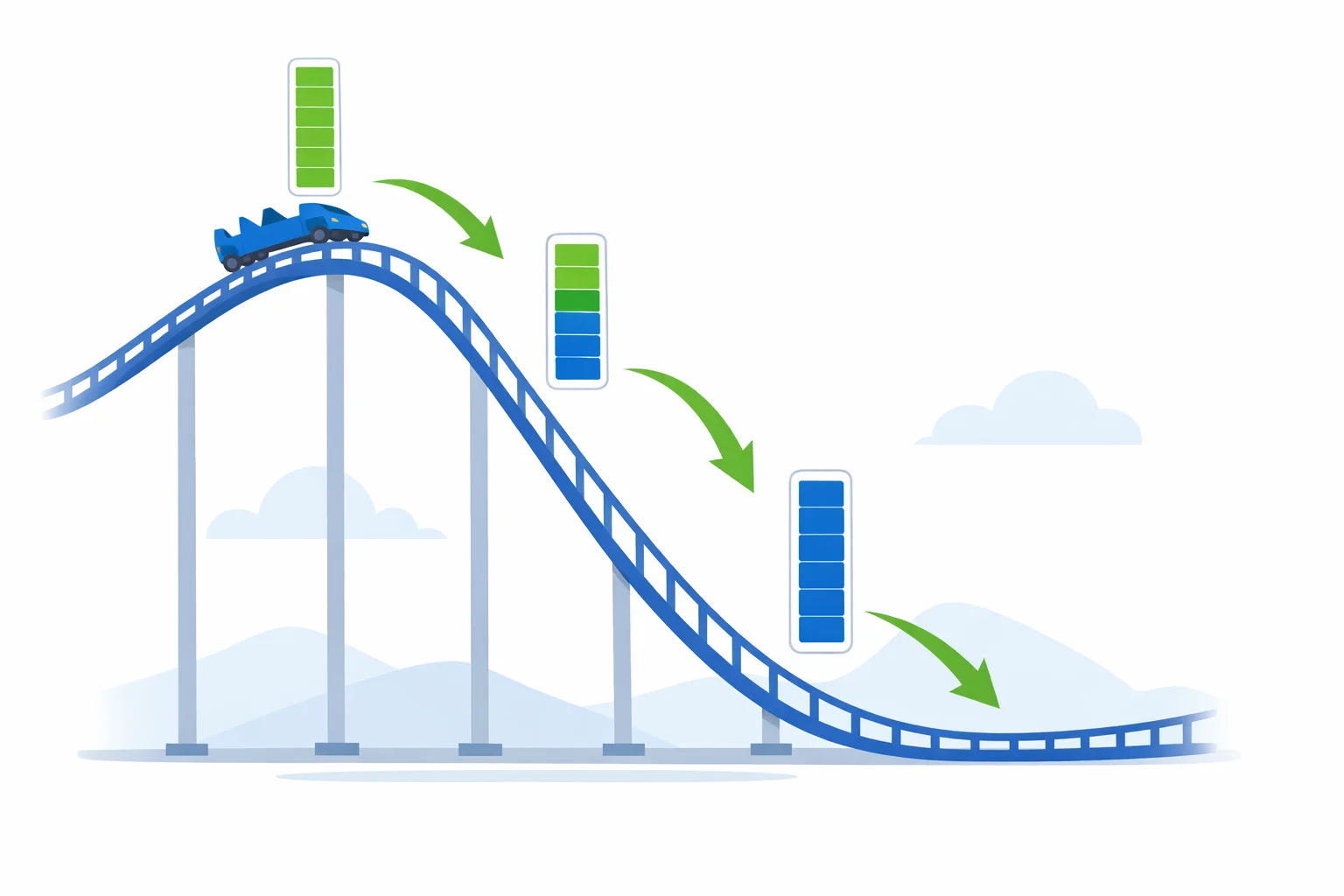
A 500 kg roller coaster car starts from rest at the top of a 40 m drop and reaches the bottom, which we'll call h = 0. No friction. How fast is it going at the bottom?
Set up the energy equation. At the top: v₁ = 0 m/s, h₁ = 40 m. At the bottom: h₂ = 0 m, and v₂ is what we want.
½(500)(0²) + (500)(9.81)(40) = ½(500)(v₂²) + (500)(9.81)(0)
0 + 196,200 = 250 × v₂²
v₂² = 784.8
v₂ = 28.01 m/s ≈ 100.8 km/h
Notice the mass cancels — you'd get the same 28 m/s whether the car weighed 500 kg or 5,000 kg. That's 100.8 km/h (62.7 mph) from a standstill, purely from gravity. Use our kinetic energy calculator to confirm: ½ × 500 × 28.01² = 196,140 J, matching the initial PE within rounding error.
When Friction Steals the Energy
Real systems aren't frictionless. Brake pads, air resistance, bearing friction — they all convert mechanical energy into heat. The energy doesn't disappear (conservation still holds for the totalenergy including thermal), but it's no longer available as motion or height.
The practical impact is simple: friction always reduces the final speed or the maximum height an object can reach. If friction removes 800 J from a system that starts with 1,962 J of potential energy, only 1,162 J is available for kinetic energy at the bottom.
You calculate friction work as Wfriction = f × d, where f is the friction force and d is the distance traveled (not the height difference — the actual path length along the surface). Use the work calculator to find the work done by friction for a given force and distance.
Worked Example: Playground Slide with Friction
A 30 kg child starts from rest at the top of a 4 m high slide. The slide surface exerts a constant friction force of 30 N over a 6 m path length. What's the child's speed at the bottom?
W_friction = 30 N × 6 m = 180 J
PE₁ = mgh = 30 × 9.81 × 4 = 1,177.2 J
KE₁ = 0 (starting from rest)
½mv₂² = PE₁ − W_friction = 1,177.2 − 180 = 997.2 J
v₂ = √(2 × 997.2 / 30) = √66.48 = 8.15 m/s
Without friction, v₂ would be √(2 × 9.81 × 4) = 8.86 m/s. Friction shaved off about 0.7 m/s — roughly 8% of the frictionless speed. That 180 J went straight into heating the slide surface. On a hot day, you can feel that energy as warmth on the back of your legs.
Energy Methods vs. Kinematics — When to Use Which
Students often ask: why bother with energy when I can just use v² = v₀² + 2a·d? Fair question. Both methods give the same answer for straight-line, constant-acceleration problems. But energy conservation wins in three situations:
- Curved paths. A roller coaster loop, a pendulum arc, a ski slope with changing steepness — kinematics needs the acceleration at every point. Energy conservation only cares about the start and end heights.
- Unknown forces. If you don't know the normal force along a curved surface, you can't find acceleration. But you can still use energy if you know the height change and the friction loss.
- Multi-step problems. Object goes up, comes down, bounces — instead of chaining kinematics equations, one energy equation from start to finish handles it all.
Kinematics wins when you need time. Energy conservation tells you speeds and heights but says nothing about how long the trip takes. For time-dependent questions, you still need v = v₀ + at or its relatives.
Three Scenarios Beyond the Textbook
Hydroelectric dam. Water stored 200 m above a turbine has PE = mgh = 1,000 × 9.81 × 200 = 1.96 MJ per cubic meter. The dam converts maybe 90% of that to electrical energy — the rest goes to friction in the pipes and turbine bearings. Use the efficiency calculator to find how much power actually makes it to the grid.
Pole vault. An elite vaulter sprints at about 9.5 m/s, converting KE = ½(80)(9.5²) = 3,610 J into PE = mgh = 80 × 9.81 × h. Solving for h gives 4.6 m — but the world record is 6.26 m. The extra height comes from the elastic potential energy stored in the bending pole and from the vaulter pushing off at the top. Conservation of energy still holds; you just have to count all the energy sources.
Regenerative braking. Electric cars recover kinetic energy during braking by running the motor as a generator. A 2,000 kg Tesla going 30 m/s has KE = 900,000 J. Regenerative braking might capture 60-70% of that, feeding roughly 600 kJ back into the battery. The rest becomes heat in the brake pads and motor windings — mechanical energy converted to thermal, exactly as the equation predicts.
Common Exam Traps with Energy Conservation
Forgetting to set a reference height.It doesn't matter where you put h = 0, but you have to be consistent. If the ground is h = 0, then a table 1.2 m high has h = 1.2 m. If the table is h = 0, the ground is h = −1.2 m. Either works; mixing them doesn't.
Using path length instead of height. Potential energy depends on vertical height, not the distance traveled along a slope. A 10 m ramp at 30° has a height change of 10 × sin(30°) = 5 m, not 10 m.
Assuming conservation when it doesn't apply.If the problem says "the block slides across a rough surface," friction is doing work and mechanical energy isn't conserved. You need the friction work term. If it says "smooth" or "frictionless," you're safe to drop it.
Confusing speed with velocity. Energy conservation gives speed(the magnitude), not velocity (which includes direction). A ball thrown upward at 15 m/s returns to the same height at 15 m/s downward — same KE, opposite velocity. If you need direction, you'll have to think about the physics beyond just the energy equation.