AP Physics C Score Calculator: How to Predict Your Mechanics & E&M Grades
An AP Physics C score calculatorlets you predict your final 1-5 AP grade for both the Mechanics and Electricity & Magnetism exams before official results arrive in July. AP Physics C is unique among AP science exams because it consists of two entirely separate, independently scored tests — each with its own multiple-choice and free-response sections. Whether you just finished one or both exams or you're working through practice tests at home, entering your raw scores here gives you an instant, data-driven estimate of where you stand.
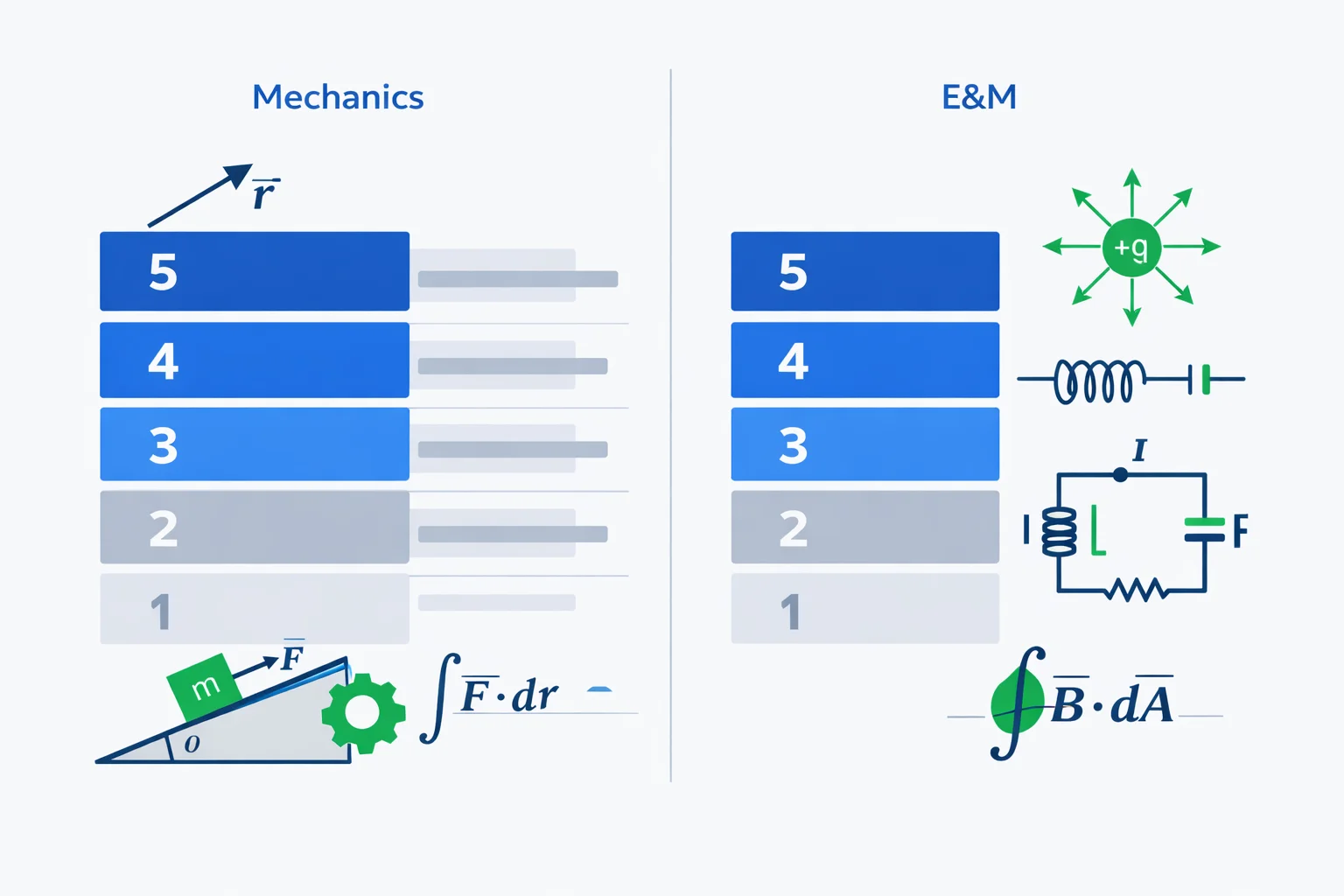
What Is AP Physics C?
AP Physics C is a calculus-based college-level physics course offered by the College Board. Unlike AP Physics 1 (which is algebra-based and covers broad topics), Physics C dives deep into fewer topics using differential and integral calculus. The course is split into two distinct halves: Mechanics and Electricity & Magnetism (E&M). Each half has its own AP exam, its own score, and earns its own college credit.
The Mechanics exam covers kinematics, Newton's laws, work and energy, momentum, rotation, and oscillations — all through a calculus lens. The E&M exam covers electrostatics, conductors and capacitors, electric circuits, magnetic fields, and electromagnetic induction. Together, they correspond to two semesters of college-level introductory physics for science and engineering majors.
Mechanics vs. Electricity & Magnetism: Two Separate Exams
A critical fact many students miss: AP Physics C Mechanics and AP Physics C E&M are two independent exams. You can take one, the other, or both. Each exam is 90 minutes long. If you take both on exam day, you'll sit for a total of 3 hours with a break between them.
Here is how the two exams compare:
| Feature | Mechanics | E&M |
|---|---|---|
| Duration | 90 minutes | 90 minutes |
| MCQ Questions | 35 (45 min) | 35 (45 min) |
| FRQ Questions | 3 (45 min) | 3 (45 min) |
| Test Takers (2024) | ~65,000 | ~30,000 |
| Pass Rate (3+) | ~62% | ~54% |
| % Earning a 5 | ~26% | ~24% |
| Calculus Required | Yes (derivatives, integrals) | Yes (more advanced integrals) |
About twice as many students take Mechanics compared to E&M. Many schools offer only the Mechanics course, and students who do take both usually find that E&M is more challenging due to the abstract nature of electric and magnetic fields and the heavier use of multivariable integration.
How AP Physics C Scoring Works
Each exam is scored independently using the same structure. Your raw scores are calculated first, then converted to the 1-5 AP scale:
- MCQ Raw Score = Number of correct answers out of 35 (no guessing penalty)
- FRQ Raw Score = Sum of points across 3 questions, each worth 15 points (max 45)
- Composite %= (MCQ% + FRQ%) / 2, where MCQ% = MCQ Raw / 35 × 100 and FRQ% = FRQ Raw / 45 × 100
The College Board then applies annual equating adjustments to set the final cutoff thresholds. Because both the MCQ and FRQ sections count for exactly 50% each, strong FRQ performance can compensate for a weaker MCQ section and vice versa.
Raw Score to AP Grade Conversion Tables
Based on historical data, here are the estimated composite percentage thresholds for each AP grade on both exams:
Mechanics cutoffs:
- 5 (Extremely well qualified): 67%+ — roughly 24 MCQ correct and 30 FRQ points
- 4 (Well qualified): 53-66% — roughly 19 MCQ and 24 FRQ points
- 3 (Qualified): 40-52% — roughly 14 MCQ and 18 FRQ points
- 2 (Possibly qualified): 27-39% — roughly 10 MCQ and 12 FRQ points
- 1 (No recommendation): Below 27%
Electricity & Magnetism cutoffs:
- 5: 62%+ — roughly 22 MCQ correct and 28 FRQ points
- 4: 49-61% — roughly 17 MCQ and 22 FRQ points
- 3: 37-48% — roughly 13 MCQ and 17 FRQ points
- 2: 25-36% — roughly 9 MCQ and 11 FRQ points
- 1: Below 25%
Notice that E&M has slightly lower cutoff thresholds than Mechanics, reflecting the exam's higher difficulty level. A composite score of 62% earns a 5 on E&M, while you need 67% for a 5 on Mechanics.
FRQ Breakdown and Scoring Rubric Tips
Each AP Physics C exam has 3 free-response questions, each worth 15 points. The FRQ section is where most students leave points on the table — and where improvement has the biggest impact on your final grade. Here is how FRQs are typically structured:
Mechanics FRQ topics:
- FRQ 1 — Translational motion: forces, Newton's laws, and kinematics with calculus
- FRQ 2 — Rotational motion: torque, angular momentum, moment of inertia
- FRQ 3 — Energy and momentum: work-energy theorem, conservation laws, collisions
E&M FRQ topics:
- FRQ 1 — Electrostatics: Gauss's law, electric potential, charge distributions
- FRQ 2 — Circuits and magnetism: RC circuits, Biot-Savart law, Ampère's law
- FRQ 3 — Electromagnetic induction: Faraday's law, inductors, LC circuits
AP readers award partial credit generously. Always show your work: set up the integral or differential equation, show each step of the algebra, and state your final answer with units. Students routinely earn 8-10 out of 15 points on problems where they did not reach the correct final answer but demonstrated valid physics reasoning.
AP Physics C Score Distributions by Year
AP Physics C has significantly higher pass rates than AP Physics 1, primarily because students who take Physics C tend to be stronger in math and science. Here is the five-year trend:
Mechanics: The pass rate (3 or higher) has remained between 60-65% over the past five years, with 25-29% of students earning the top score of 5. In 2024, 26.4% scored a 5, 18.6% a 4, and 17.8% a 3 — for a total pass rate of 62.8%.
E&M:Pass rates are slightly lower at 53-57%, with 24-28% earning a 5. In 2024, 24.3% scored a 5, 14.7% a 4, and 14.9% a 3 — for a pass rate of 53.9%. Notably, the E&M exam has a larger percentage of students scoring a 1 (around 28%) compared to Mechanics (around 20%), reflecting the exam's steeper difficulty curve.
Common Mistakes That Cost Points on AP Physics C
- Forgetting the constant of integration: When solving differential equations on the FRQ, omitting the +C or not applying initial conditions to solve for it costs 1-2 points per problem.
- Wrong integral limits:Setting up a Gauss's law or work integral with incorrect bounds is one of the most common errors on E&M FRQs. Always draw a diagram and label your limits explicitly.
- Ignoring vector directions:Physics C requires careful attention to signs and directions. Forgetting the negative sign in Faraday's law or getting the direction of a cross product wrong costs full marks on that part.
- Skipping the equation sheet review: You DO receive a formula sheet on Physics C (unlike Physics 1). Study it before exam day so you can quickly find what you need rather than wasting time searching.
- Rushing through MCQs: With 35 questions in 45 minutes, you have about 77 seconds per question. Many students rush and make careless errors. If a question is taking too long, flag it and return to it later.
How to Improve Your AP Physics C Score
If your predicted score is lower than your target, these strategies have the highest return on study time:
- Practice released FRQs under timed conditions: The College Board publishes past FRQs with scoring rubrics. Work through at least 10 problems from each exam under timed conditions and grade yourself against the rubric. This is the single most effective preparation method.
- Strengthen calculus fundamentals: If integration by parts, partial fractions, or basic differential equations feel shaky, spend time on those before tackling physics problems. A weak calculus foundation makes every physics problem harder.
- Master the formula sheet:Know what is and isn't on the provided equation sheet. Memorize key derivations (e.g., the electric field of a uniformly charged sphere) that often appear as intermediate steps.
- Focus on your weaker section: If your MCQ scores are consistently higher than your FRQ scores, dedicate more study time to free-response practice. Since both sections are weighted equally at 50%, the section where you have the most room to grow gives you the biggest score boost.
- Use the AP Physics 1 calculator to review algebra-based fundamentals: Many Physics C errors stem from shaky understanding of basic physics concepts covered in Physics 1. Reviewing those foundations can prevent careless mistakes on simpler sub-parts of FRQs.
When to Use This AP Physics C Score Calculator
This AP Physics C score calculator is most useful in these situations:
- After taking a full-length practice exam for Mechanics, E&M, or both — to convert raw scores to predicted AP grades
- Right after the actual AP exam to estimate your score while your answers are fresh
- During study planning to set target raw scores for each section and understand what it takes to reach the next grade level
- When deciding whether to take both Physics C exams or just Mechanics — use the score distributions to gauge your likelihood of passing E&M
- To compare your performance on Mechanics vs. E&M and identify which exam needs more preparation time
Remember that all score predictions are estimates based on historical College Board data. Exact cutoffs shift by 1-3 percentage points each year due to statistical equating. For the algebra-based Physics 1 exam, try our AP Physics 1 Score Calculator for a tailored prediction with its own MCQ and FRQ structure.