AP Physics 1 Grade Calculator: Understanding Score Cutoffs and Grade Conversion
An AP Physics 1 grade calculator converts your raw exam scores into the 1-5 AP grade scale used by colleges for credit and placement decisions. Whether you just finished a practice test, walked out of the May exam, or want to set a target score for your study plan, understanding exactly how raw points translate to AP grades helps you make smarter preparation choices. This guide breaks down the score conversion process, grade boundaries, college credit policies, and strategies to push your grade higher.
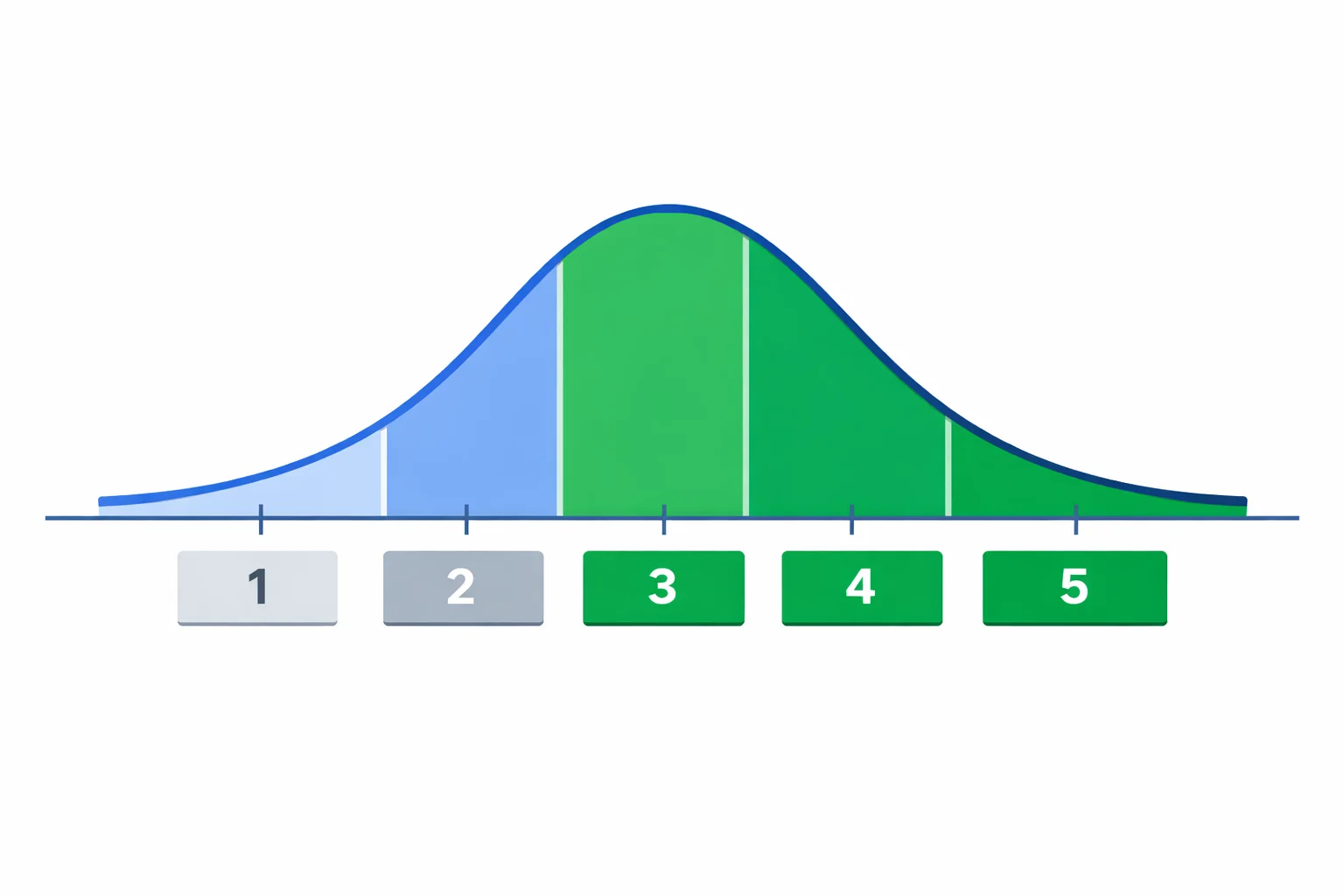
What Is AP Physics 1 Grade Conversion?
AP Physics 1 grade conversion is the process the College Board uses to turn your raw exam performance into a final grade on the 1-5 scale. The exam has two sections — 40 multiple-choice questions and 5 free-response questions — and each section accounts for 50% of your total score. Your raw points are combined into a composite score, which is then compared against grade boundary thresholds to determine your final AP grade.
The 1-5 scale corresponds to college-level performance benchmarks: 5 means "extremely well qualified," 4 means "well qualified," 3 means "qualified" (the minimum for credit at most schools), 2 means "possibly qualified," and 1 means "no recommendation." This grading system was designed so that AP scores directly map to letter grades in a comparable introductory college course — a 5 corresponds to an A, a 4 to a B+, and a 3 to a B.
How AP Physics 1 Grade Boundaries Work
Grade boundaries are the minimum composite percentages needed to earn each AP grade. Based on historical data, a 5 requires approximately 69% or higher, a 4 requires about 53%, a 3 requires about 39%, and a 2 requires about 26%. Anything below 26% results in a 1. These thresholds are recalibrated each year through a statistical process called equating, which ensures that a grade of 3 in one year represents the same level of mastery as a 3 in any other year.
The equating process means that if a particular year's exam is harder than usual, the cutoffs are lowered slightly so students aren't penalized. Conversely, an easier exam may have slightly higher cutoffs. In practice, boundaries shift by only 1-3 percentage points from year to year. For a detailed section-by-section breakdown using individual FRQ scores, try our AP Physics 1 Score Calculator.
Raw Score to AP Grade Conversion Table
Below is a reference table showing the estimated raw score ranges for each AP Physics 1 grade. The MCQ and FRQ columns show approximate scores assuming balanced performance across both sections:
| AP Grade | Composite % | MCQ Correct (of 40) | FRQ Points (of 60) |
|---|---|---|---|
| 5 | 69%–100% | 28–40 | 40–60 |
| 4 | 53%–68% | 22–27 | 31–39 |
| 3 | 39%–52% | 16–21 | 23–30 |
| 2 | 26%–38% | 11–15 | 15–22 |
| 1 | 0%–25% | 0–10 | 0–14 |
Remember that these are approximate ranges. A student who scores exceptionally well on FRQs can earn a 5 with fewer MCQ correct answers, and vice versa, since both sections are weighted equally at 50%.
Understanding Your Composite Score
Your composite score is the single number that determines your AP grade. It's calculated as the average of your MCQ section percentage and your FRQ section percentage:
Composite % = (MCQ Correct / 40 x 100 + FRQ Points / 60 x 100) / 2
For example, if you answer 25 MCQ questions correctly and earn 35 FRQ points, your composite would be (62.5% + 58.3%) / 2 = 60.4%. That composite of 60.4% falls in the grade 4 range (53-68%), so you would earn a 4 — "well qualified."
One critical insight: because both sections carry equal weight, improving your weaker section is almost always more efficient than polishing your stronger one. A student scoring 90% on MCQ but only 40% on FRQ has a composite of 65% (grade 4). Boosting that FRQ to 55% would push the composite to 72.5% (grade 5) — a 15-point FRQ improvement that crosses a grade boundary.
College Credit Acceptance by AP Grade
One of the primary reasons students take AP Physics 1 is to earn college credit. However, credit policies vary widely by institution and by grade:
- Grade 5: Accepted at virtually all colleges and universities, including MIT, Caltech, Stanford, and Ivy League schools. Most award 3-4 credit hours for introductory physics.
- Grade 4: Accepted at most schools, including state universities and many selective colleges. Some highly selective institutions require a 5.
- Grade 3: Accepted at many colleges — the College Board considers this the "qualified" threshold. Most state universities accept a 3, but competitive schools often require a 4 or 5.
- Grades 2 and 1: Rarely or never accepted for credit. A 2 is officially "possibly qualified" but almost no institution awards credit for it.
Always check each college's specific AP credit policy before assuming your grade will count. Some schools offer placement (skipping the intro course) without credit, while others offer full credit hours. If you're considering AP Physics C instead, check our AP Physics C Score Calculator to compare the two exams.
AP Physics 1 Grade Distribution Trends
AP Physics 1 consistently has one of the lowest pass rates among all AP exams. Over the past five years (2020-2024), the pass rate (grade 3 or higher) has ranged from 47.4% to 50.8%. Only about 7-9% of students earn a 5 in any given year.
For context, here is how AP Physics 1 compares to other AP science exams:
- AP Physics 1: ~48% pass rate, ~8% earn a 5
- AP Physics 2: ~65% pass rate, ~14% earn a 5
- AP Physics C Mechanics: ~72% pass rate, ~28% earn a 5
- AP Physics C E&M: ~69% pass rate, ~30% earn a 5
The lower pass rate on AP Physics 1 doesn't necessarily mean it's the hardest physics exam. AP Physics 1 is taken by a broader, less self-selected student population, including many first-year physics students. AP Physics C is typically taken by students with stronger math backgrounds and more physics experience, which contributes to its higher pass rate. For detailed predictions on the AP Physics 2 exam, see our AP Physics 2 Score Calculator.
Common Grade Conversion Mistakes
Students frequently make errors when estimating their AP grade from raw scores. Here are the most common pitfalls:
- Assuming a flat percentage scale: A 70% does not automatically mean a grade of 3 like in a typical school class. The AP grading scale is nonlinear — 69% is enough for a 5, while 39% earns a 3.
- Ignoring the FRQ weight: Many students focus exclusively on MCQ performance, but FRQs account for a full 50% of the composite score. Neglecting FRQ preparation is one of the biggest strategic errors.
- Overestimating FRQ scores: Students tend to overrate their FRQ performance because they remember writing "something." AP readers follow strict rubrics, and partial credit is awarded only for specific reasoning steps — not for effort.
- Confusing scaled and raw scores: The composite percentage and the 1-5 AP grade are different numbers. A composite of 55% does not mean you got "55% of the exam right" — it means your weighted average across both sections was 55%.
How to Improve Your AP Physics 1 Grade
If the calculator shows a lower grade than your target, here are proven strategies to move up to the next grade level:
- Target your weaker section: Since MCQ and FRQ are weighted equally, identify which section drags your composite down and focus study time there. Most students improve more efficiently on FRQs because partial credit makes each point of improvement easier to earn.
- Practice with released FRQs and rubrics: The College Board publishes past FRQs with official scoring guidelines. Study the rubrics to understand what earns full credit — it's often not just the right answer, but the right reasoning format.
- Master conceptual reasoning: AP Physics 1 emphasizes understanding over computation. Practice explaining "why" — why does a ball on a string speed up when the radius shrinks? Why does current split unevenly in a parallel circuit? These are the types of questions that separate a 3 from a 5.
- Eliminate careless errors: On MCQ, many points are lost to misreading questions or making sign errors. Slow down on questions you think you know — overconfidence causes more wrong answers than difficulty.
- Time yourself on practice tests: Running out of time is a grade killer. Practice completing the MCQ section in 80 minutes (saving 10 minutes for review) and each FRQ in 25 minutes.
When to Use This Grade Calculator
This AP Physics 1 grade calculator is most valuable in these situations:
- After scoring a practice test — enter your composite percentage to instantly see your predicted AP grade and how close you are to the next level
- During study planning — set a target grade and work backward to find the minimum MCQ and FRQ scores you need
- Right after the AP exam — estimate your grade while your performance is still fresh in your mind
- When comparing exam options — use this alongside other AP score calculators to decide between AP Physics 1 and AP Physics C
- For college application planning — determine whether your predicted grade meets the credit requirements of your target schools
For a more detailed prediction that accepts individual FRQ scores for each of the 5 questions, use our AP Physics 1 Score Calculator, which provides section-by-section breakdowns and personalized improvement recommendations.